Rethinking the Rule of 100: A Modern Approach to Investment Risk

Rethinking the Rule of 100

A Story to Begin With

Two investors walk into the same financial planning office.

The first is 28 years old, earning a decent salary but juggling a home loan, car EMI, and plans for a child’s education. The second is 62, recently retired, debt-free, with accumulated savings and a steady pension.

According to the Rule of 100, the younger investor should aggressively invest in equities, while the older one should sharply reduce stock exposure. But when you look at their real financial lives, the picture feels counterintuitive. The younger investor cannot afford large losses, while the retired investor may actually have the stability to ride out market volatility.

This disconnect raises an important question:
Should age alone determine how much investment risk you take?

That question sits at the heart of this article.


The Rule of 100 – Asset Allocation by Age

When it comes to investing, one of the most common questions people ask is:
How much should I invest in equities and how much in safer assets?

To simplify this decision, financial planners have long relied on age-based formulas—the most popular being the Rule of 100.

At first glance, the rule seems logical and easy to follow. But does it truly reflect how real people earn, save, and spend today? Let’s take a closer look.


What Is the Rule of 100?

The Rule of 100 is a basic guideline used to determine asset allocation based on age.

Formula:
100 − Your Age = Percentage of your portfolio invested in equities

The remaining portion is allocated to bonds, debt instruments, or other relatively low-risk assets.

Simple Examples

  • Age 30
    • 70% in stocks
    • 30% in bonds/debt
  • Age 50
    • 50% in stocks
    • 50% in bonds/debt

The Logic Behind the Rule

The rule is built on a straightforward assumption:
risk tolerance declines with age.

Younger investors are expected to have:

  • Longer investment horizons
  • More time to recover from market downturns

Older investors, on the other hand, are assumed to:

  • Prefer stability over growth
  • Focus on capital preservation and steady income

This thinking made sense decades ago—but markets, careers, and lifespans have changed.


Why the Rule Evolved: Rule of 110 and Rule of 120

As life expectancy increased and inflation became a bigger threat, financial advisors began adjusting the formula.

Rule of 110

110 − Age = Equity allocation

  • Age 30 → 80% equities
  • Age 50 → 60% equities

This version recognizes that:

  • People are working longer
  • Retirement needs are larger
  • Equity growth is crucial to beat inflation

Rule of 120

120 − Age = Equity allocation

  • Age 30 → 90% equities
  • Age 50 → 70% equities

This rule is typically suggested for investors with higher risk tolerance or those relying heavily on equity markets for long-term wealth creation.

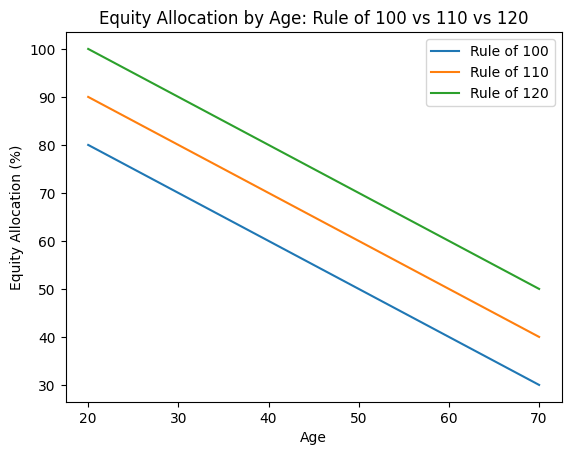
A comparison of Rule of 100 vs Rule of 110 vs Rule of 120 is shown in the chart below:
What the Chart Shows

  • X-axis: Investor age
  • Y-axis: Suggested equity allocation (%)

Three declining lines represent:

  • Rule of 100 (most conservative)
  • Rule of 110 (moderate)
  • Rule of 120 (most aggressive)

Key Takeaways:

  • All three rules reduce equity exposure linearly with age
  • The difference between rules becomes more pronounced at younger ages
  • Even at age 60–70, Rule of 120 still suggests meaningful equity exposure, reinforcing the inflation-risk argument

The Big Problem With All These Rules

Despite their popularity, the Rule of 100, 110, and 120 share one major flaw:

They assume age alone determines risk capacity.

In reality, age tells only part of the story.


A Contrarian Perspective: When the Rule Breaks Down

Younger Investors Aren’t Always Risk-Takers

Many young investors face:

  • Lower incomes and limited savings
  • Home loans, car EMIs, and education expenses
  • Small emergency buffers

For them, a sharp market fall can cause real financial stress. Even though time is on their side, their ability to absorb losses may be limited. In such cases, aggressive equity exposure can do more harm than good.

Older Investors May Have Higher Risk Capacity

Ironically, many older or retired investors:

  • Are free from major financial obligations
  • Have accumulated wealth, pensions, or rental income
  • Can emotionally handle short-term volatility

For them, maintaining meaningful equity exposure may actually be necessary to protect purchasing power against inflation.


The Real Question: Risk Tolerance or Risk Capacity?

This is where most age-based rules fall short.

  • Risk tolerance is how comfortable you feel with volatility
  • Risk capacity is whether your finances can survive a downturn

Risk capacity depends far more on:

  • Cash flows
  • Liabilities
  • Financial security
  • Emergency reserves

—not just your age.


Final Thoughts

The Rule of 100 and its modern variations are useful starting points, not formulas to follow blindly.

Smart asset allocation requires balancing:

  • Age
  • Income stability
  • Financial responsibilities
  • Long-term goals
  • The ability—not just the willingness—to take risk

In investing, simplicity helps.
But context matters even more.


What Do You Think?

  • Should age alone determine how much risk an investor takes?
  • Have your financial responsibilities increased or reduced your ability to invest in equities?
  • For younger investors with EMIs, is aggressive equity allocation practical—or risky?
  • Should retired investors reduce equity exposure simply because of age?
  • Which matters more: risk tolerance or risk capacity?
  • Do you follow the Rule of 100 (or 110/120), or have you created your own approach?

👉 Share your views—your experience may help others rethink how they invest.

The Magnificent 7: Are AI Stocks Setting Up for a Bubble?

Overview

As of late 2024, the Magnificent 7 — Alphabet (Google), Amazon, Apple, Meta Platforms, Microsoft, Nvidia, and Tesla — collectively account for $16 trillion of the S&P 500’s $46 trillion total market capitalization.
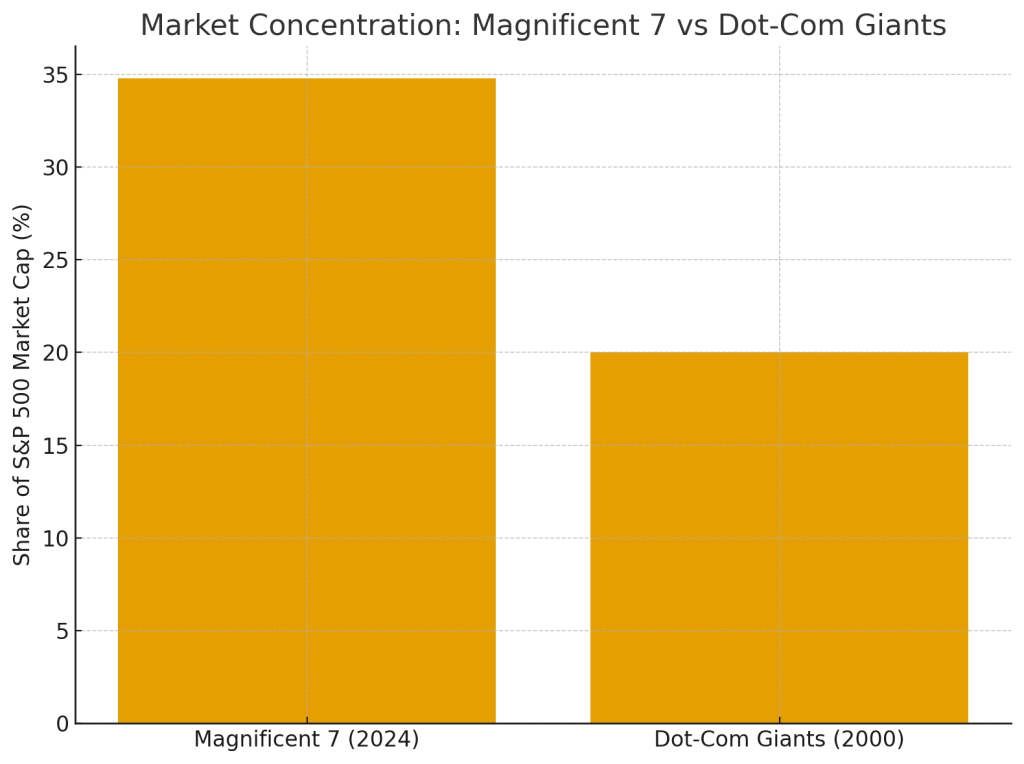
This means these seven companies alone represent 34.8% of the entire index, a massive increase from about 10% in 2014.

For historical context, even during the dot-com bubble of 2000, the largest tech companies never exceeded 20% of the S&P 500. Today’s concentration level is therefore unprecedented.

Over the recent years, the heavy weighting of AI-focused companies has been a major driver of the S&P 500’s growth. This dependence has led many analysts to warn of a potential AI-driven valuation bubble and the risk of a sharp correction if expectations disappoint.

Risk of an AI Bubble Bursting

1. Valuation Risk

AI-focused companies are increasingly trading at valuations that far exceed their underlying fundamentals, echoing patterns seen during the Dot-Com era. For example, Palantir reported $1.18 billion in Q3 2025 revenue and is projecting around $4.40 billion for the full year. Yet its market capitalisation surged to nearly $450 billion, implying a valuation of 115–120× sales—levels typically associated with speculative excess rather than sustainable financial performance. This disconnect between valuation and fundamentals heightens the risk of sharp corrections if anticipated growth fails to materialize.

Many analysts argue that valuations are pricing in hyped future revenues, not current financial performance or realistic near-term applications of AI.

2. Capex vs. Actual Returns

Big Tech is expected to invest $5 trillion on AI-related infrastructure — data centers, chips, model training, and energy facilities.

However, the return profile does not yet justify this scale of investment:

  • Only around 5% of businesses currently use AI in full production environments.
  • Productivity gains remain slow and uneven.
  • Many AI tools still lack clear monetization paths.

This mismatch heightens the risk that expected AI-driven profits may not materialize soon enough to justify the massive capital outlay.

3. Rising Debt Financing

Despite being historically cash-rich, AI-focused tech giants have been taking on large amounts of debt to finance data-center expansion.

For example:

  • Oracle reported $124 billion in total obligations (including operating lease liabilities) as of Nov 2025 — up from $89 billion a year earlier.
  • Weak earnings combined with rising debt prompted S&P and Moody’s to revise Oracle’s credit outlook to negative.

Analysts see parallels to the dot-com era, when companies overborrowed to fund speculative, unproven technologies. If AI revenues lag, these debt loads could rapidly become unsustainable.

4. “Circular” Investment and Revenue Deals

An emerging concern is the rise of vendor-financed growth loops within the AI ecosystem.

A notable example involves:

  • Nvidia, which committed up to $100 billion in staged investments into OpenAI, contingent on the deployment of new AI infrastructure (e.g., gigawatts of data-center capacity).
  • OpenAI then uses the capital to purchase Nvidia chips, creating a circular flow of investment → purchase → revenue.

Analysts and regulators have pointed out that this model may artificially inflate demand and revenue, echoing vendor-financing practices seen in earlier speculative periods.

5. Concentration Risk in the S&P 500

With the Magnificent 7 making up nearly one-third of the total S&P 500, the broader market’s stability is increasingly tied to the performance of a small cluster of AI-centric companies.

A synchronized decline in these firms — due to AI monetization delays, regulatory pressure, competitive threats, or earnings disappointments — could:

  • Trigger broad market corrections
  • Mirror the systemic tech collapse of 2000
  • Reduce retirement savings, given heavy household exposure to index funds
  • Increase volatility across global equity and credit markets

The S&P 500’s dependence on a single technological narrative — AI dominance — heightens systemic vulnerabilities.


Summary

The rapid rise of AI has created unprecedented concentration within the S&P 500. While AI has transformative potential and the Magnificent 7 possess stronger fundamentals than the tech leaders of 2000, valuation excesses, massive capex commitments, rising debt, circular revenue arrangements, and extreme index concentration have raised concerns about a potential AI bubble.

If AI growth and monetization fall short of current expectations, the resulting correction could echo — or potentially exceed — the impact of the dot-com crash.

How to use RSI for Trading Success

Relative Strength Index (RSI)


A momentum indicator developed by J. Welles Wilder Jr. (1978) that measures the speed and magnitude of price changes. Traders use RSI to identify whether a stock is overbought or oversold.

RSI Scale

RSI moves between 0 and 100.

RSI Formula (Simple Version)

  • RS = Average Gains / Average Losses
  • RSI = 100 – [100 / (1 + RS)]

(You don’t usually need to calculate it manually—charting tools do it automatically.)

How to Read RSI

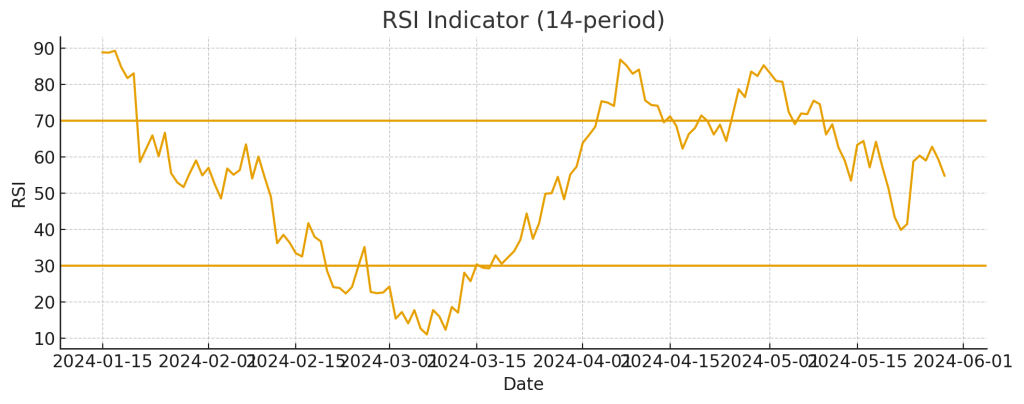
Overbought (RSI > 70)

  • An RSI above 70 suggests that the asset may be overbought, indicating a potential price correction.

Oversold (RSI < 30)

  • An RSI below 30 suggests the asset may be oversold, indicating a possible rebound.

Example Chart Explanation

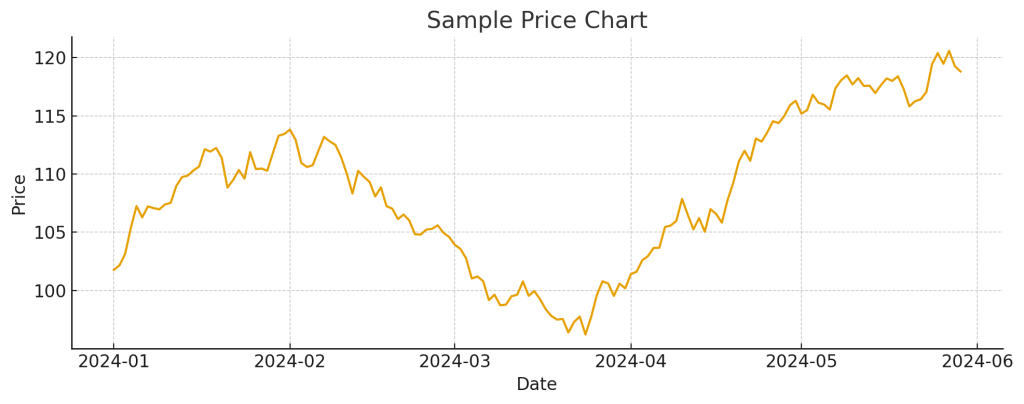
1. Price Chart

(shows the stock’s price movement over time.)

2. RSI Chart

(shows RSI oscillating between 0 and 100 with reference lines at 30 and 70.)

Overbought Example

When RSI rises above 70:

  • Momentum is strong but may be overstretched.
  • When RSI turns back below 70, the price often slows down or pulls back.

Oversold Example

When RSI falls below 30:

  • Indicates strong downside pressure.
  • When RSI rises above 30, price often stabilizes or rebounds.

How Traders Use RSI

  1. Entry Signal (Buy) : RSI crosses above 30 → possible buying opportunity.
  2. Exit Signal (Sell) : RSI crosses below 70 → possible selling signal.
  3. Trend Reversals (Divergence) Traders watch for differences between price movement and RSI movement:
    • Bullish Divergence:
      Price makes lower lows, but RSI makes higher lows.
      → Suggests a potential upward reversal.
      → Buy when RSI crosses above 30.
    • Bearish Divergence:
      Price makes higher highs, but RSI makes lower highs.
      → Suggests a potential downward reversal.
      → Sell when RSI crosses below 70.

Limitations

  • RSI can stay overbought or oversold for long periods during strong trends.
  • It may give false signals in sideways or choppy markets.
  • Works best when combined with price action, moving averages, MACD, or volume confirmation.

Conclusion

The RSI is a simple yet powerful indicator that helps traders understand momentum and identify potential turning points in the market. While it provides helpful signals for entries, exits, and trend reversals, it should not be used alone. Combining RSI with other technical tools and overall market context leads to more reliable and confident trading decisions.


Understanding Moving Averages in Trading

Moving Average (MA)

A moving average represents the average price of a security over a specific period, helping traders smooth out short-term price fluctuations and identify overall trends.

Types of Moving Averages

TypePeriod CoveredUsageTrend Focus
200-Day Moving Average (200-DMA)Last 200 trading daysLong-term trend identificationBroad market direction
50-Day Moving Average (50-DMA)Last 50 trading daysShort- to intermediate-term analysisRecent price momentum

How to Interpret a Moving Average

Golden Cross (Bullish Signal)

Definition:
Occurs when the 50-DMA crosses above the 200-DMA.

Interpretation:
→ Signals a bullish trend, indicating potential long-term upward momentum.
The crossover shows that short-term momentum is overtaking long-term averages, suggesting renewed market strength.

Confirmation:
Traders look for increasing trading volumes or other indicators (like RSI or MACD) to validate the uptrend.

Death Cross (Bearish Signal)

Definition:
Occurs when the 50-DMA crosses below the 200-DMA.

Interpretation:
→ Signals a bearish trend, indicating potential long-term downward momentum.
This suggests that short-term weakness is overtaking long-term support levels.

Confirmation:
Traders often seek validation through
• A break of key support levels
Declining trading volumes
• Other bearish indicators

Example: Golden Cross – Northern ARC Capital Ltd

Northern ARC Capital Ltd (Chart source : https://www.screener.in)

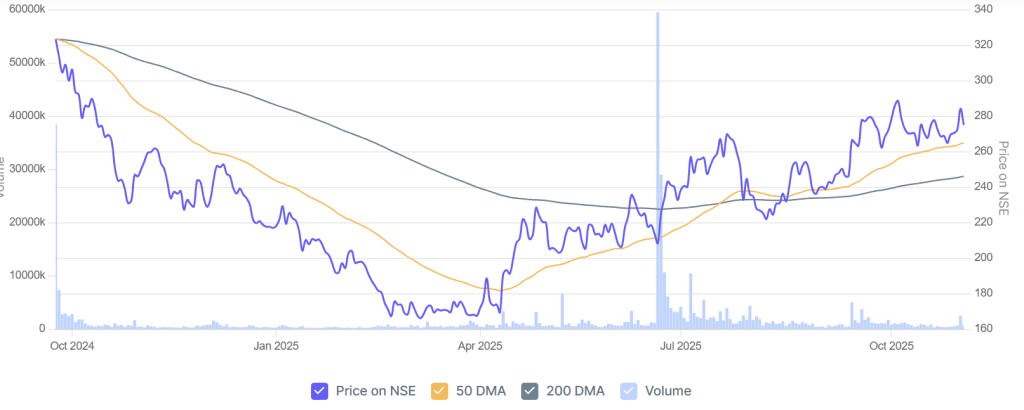
In the chart above:

  • The blue line represents the price movement of the stock on NSE.
  • The orange line is the 50-Day Moving Average (50-DMA) — short- to mid-term trend indicator.
  • The grey line is the 200-Day Moving Average (200-DMA) — long-term trend indicator.
  • The light blue bars show the trading volume.

Observations

  1. October 2024 – March 2025:
    The stock remained in a downtrend, with the 50-DMA below the 200-DMA — a bearish phase. Prices continued to decline as momentum weakened.
  2. April – June 2025:
    The price started recovering, forming higher lows. The 50-DMA began to turn upward, indicating strengthening short-term momentum.
  3. June – July 2025: The Golden Cross
    The 50-DMA crossed above the 200-DMA, forming a Golden Cross — a bullish signal suggesting a potential long-term uptrend was beginning.
    This crossover was also supported by a spike in trading volume, adding credibility to the move.
  4. August – October 2025:
    After the crossover, prices continued to trend upward, confirming the bullish reversal.

Summary

  • A Moving Average helps visualize the trend by averaging prices over time.
  • The 50-DMA tracks short- to mid-term momentum, while the 200-DMA tracks long-term direction.
  • Golden Cross → Bullish trend may be forming.
  • Death Cross → Bearish trend may be developing.
  • Always confirm signals using other indicators (RSI, MACD, Volume) before making trading decisions.

Quick Insight: RSI and MACD

Relative Strength Index (RSI):
A momentum indicator that measures the speed and magnitude of price changes.

  • RSI ranges from 0 to 100
  • Above 70 → overbought (potential pullback)
  • Below 30 → oversold (potential rebound)

Moving Average Convergence Divergence (MACD):

A trend-following momentum indicator that shows the relationship between two moving averages of a stock’s price.

  • MACD line crossing above the Signal line → bullish signal
  • MACD line crossing below the Signal line → bearish signal

These indicators help traders confirm whether a Golden Cross or Death Cross is supported by momentum strength or weakness.

Your Turn

Have you ever used moving averages to identify entry or exit points in your trades?
What signals or confirmations do you rely on most — the crossover itself, volume trends, or other indicators?

Understanding Asset Allocation for Investors

One of the key component of investment strategy for investors is allocation of their capital over various asset classes. Understanding of asset classes is important for allocation of capital as each asset class comes with it’s unique characteristics, risks, and potential returns.

Overview of Asset Classes:

  1. Equities (Stocks):
    • Represent ownership in a company.
    • Typically offer higher risk and reward (returns).
  2. Fixed Income Securities (Bonds):
    • Debt instruments where investors lend money to corporations or governments in exchange for periodic interest payments.
    • Generally offer lower risk and lower returns than equities .
    • Provide regular income, making them suitable for more conservative investors or those seeking stable income.
  3. Commodities:
    • Physical assets such as gold, oil, agricultural products, and metals.
    • Tend to act as a hedge against inflation and provide portfolio diversification.
    • Prices can be volatile due to supply and demand dynamics, geopolitical events, and economic factors.
  4. Cash and Cash Equivalents:
    • Include savings accounts, Treasury bills, money market funds, and short-term government bonds.
    • Highly liquid and low-risk, but offer lower returns, often below inflation rates.
    • Serve as a safe haven for capital preservation and short-term liquidity needs.
  5. Real Estate:
    • Investment in property such as land, residential, or commercial buildings.
    • Provides potential for steady income through rent and long-term appreciation in property value.
    • Can act as a hedge against inflation but may involve high initial costs, illiquidity, and location-specific risks.

Key takeaways on asset allocation:

  1. Equities:
    • High risk, high reward, and growth-oriented. Suitable for long-term capital appreciation but subject to market volatility.
  2. Fixed Income Securities (Bonds):
    • Lower risk, lower returns, and a source of regular income. Bonds act as a stabilizing force, especially in volatile markets. Sensitive to interest rate fluctuations.
  3. Commodities:
    • Provide diversification and inflation protection. Their prices are influenced by forces of global supply, demand, and geopolitical factors, offering opportunities in times of economic uncertainty. They often perform well when other asset classes (like equities) are underperforming, especially during inflationary periods. For example, gold typically rises during economic uncertainty or currency devaluation.
  4. Cash and Cash Equivalents:
    • Highly liquid and low-risk, but with minimal returns. Best used for short-term needs and as a liquidity cushion. Overexposure can lead to erosion of purchasing power over time because of inflation.
  5. Real Estate:
    • Offers income through rent and the potential for appreciation. However, it carries risks like illiquidity and regional market volatility. REITs offer a more liquid way to gain exposure to real estate markets.

Asset Allocation Strategies:

  • Conservative Investors: Focus on stability and capital preservation. They prioritize bonds, cash, and conservative assets like real estate and gold.
  • Aggressive Investors: Aim for long-term growth, accepting short-term volatility. They tend to favor equities, commodities, and higher-risk real estate investments.
  • Moderate Investors: Strive for a balanced portfolio, mixing equities and bonds, with smaller allocations to real estate and commodities to manage risk and achieve steady growth.

Dynamic Asset Allocation:

Asset allocation is not static. It evolves based on changes in an investor’s life stage, goals, or market conditions. Younger investors, with a longer investment horizon, tend to favor equities, while those nearing retirement may shift towards fixed-income assets to ensure stability and income generation. Rebalancing portfolios over time ensures the asset mix aligns with changing risk tolerance and financial goals.

Final Thoughts:

An optimal asset allocation strategy allows investors to balance risk and reward effectively, while adjusting to market shifts and personal financial goals. Periodic review and rebalancing ensures that portfolios continue to meet the needs of investors at different stages of their financial journey.