The Magnificent 7: Are AI Stocks Setting Up for a Bubble?

Overview

As of late 2024, the Magnificent 7 — Alphabet (Google), Amazon, Apple, Meta Platforms, Microsoft, Nvidia, and Tesla — collectively account for $16 trillion of the S&P 500’s $46 trillion total market capitalization.
This means these seven companies alone represent 34.8% of the entire index, a massive increase from about 10% in 2014.

For historical context, even during the dot-com bubble of 2000, the largest tech companies never exceeded 20% of the S&P 500. Today’s concentration level is therefore unprecedented.
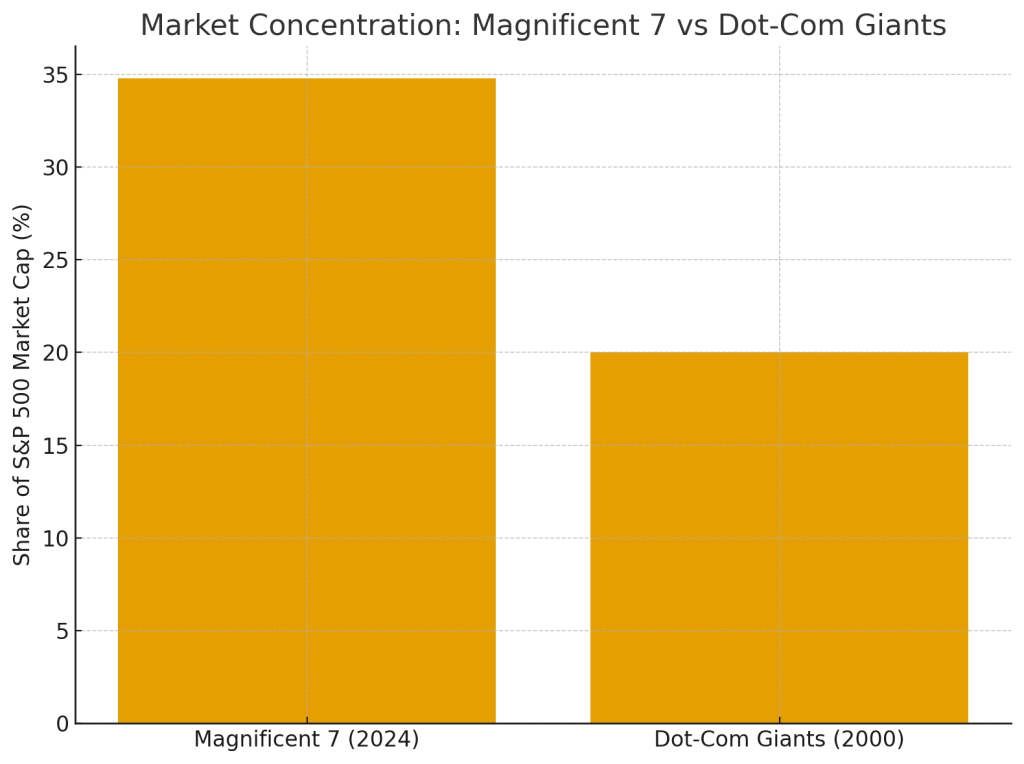
Over the recent years, the heavy weighting of AI-focused companies has been a major driver of the S&P 500’s growth. This dependence has led many analysts to warn of a potential AI-driven valuation bubble and the risk of a sharp correction if expectations disappoint.

Risk of an AI Bubble Bursting

1. Valuation Risk

AI-focused companies are increasingly trading at valuations that far exceed their underlying fundamentals, echoing patterns seen during the Dot-Com era. For example, Palantir reported $1.18 billion in Q3 2025 revenue and is projecting around $4.40 billion for the full year. Yet its market capitalisation surged to nearly $450 billion, implying a valuation of 115–120× sales—levels typically associated with speculative excess rather than sustainable financial performance. This disconnect between valuation and fundamentals heightens the risk of sharp corrections if anticipated growth fails to materialize.

Many analysts argue that valuations are pricing in hyped future revenues, not current financial performance or realistic near-term applications of AI.

2. Capex vs. Actual Returns

Big Tech is expected to invest $5 trillion on AI-related infrastructure — data centers, chips, model training, and energy facilities.

However, the return profile does not yet justify this scale of investment:

  • Only around 5% of businesses currently use AI in full production environments.
  • Productivity gains remain slow and uneven.
  • Many AI tools still lack clear monetization paths.

This mismatch heightens the risk that expected AI-driven profits may not materialize soon enough to justify the massive capital outlay.

3. Rising Debt Financing

Despite being historically cash-rich, AI-focused tech giants have been taking on large amounts of debt to finance data-center expansion.

For example:

  • Oracle reported $124 billion in total obligations (including operating lease liabilities) as of Nov 2025 — up from $89 billion a year earlier.
  • Weak earnings combined with rising debt prompted S&P and Moody’s to revise Oracle’s credit outlook to negative.

Analysts see parallels to the dot-com era, when companies overborrowed to fund speculative, unproven technologies. If AI revenues lag, these debt loads could rapidly become unsustainable.

4. “Circular” Investment and Revenue Deals

An emerging concern is the rise of vendor-financed growth loops within the AI ecosystem.

A notable example involves:

  • Nvidia, which committed up to $100 billion in staged investments into OpenAI, contingent on the deployment of new AI infrastructure (e.g., gigawatts of data-center capacity).
  • OpenAI then uses the capital to purchase Nvidia chips, creating a circular flow of investment → purchase → revenue.

Analysts and regulators have pointed out that this model may artificially inflate demand and revenue, echoing vendor-financing practices seen in earlier speculative periods.

5. Concentration Risk in the S&P 500

With the Magnificent 7 making up nearly one-third of the total S&P 500, the broader market’s stability is increasingly tied to the performance of a small cluster of AI-centric companies.

A synchronized decline in these firms — due to AI monetization delays, regulatory pressure, competitive threats, or earnings disappointments — could:

  • Trigger broad market corrections
  • Mirror the systemic tech collapse of 2000
  • Reduce retirement savings, given heavy household exposure to index funds
  • Increase volatility across global equity and credit markets

The S&P 500’s dependence on a single technological narrative — AI dominance — heightens systemic vulnerabilities.


Summary

The rapid rise of AI has created unprecedented concentration within the S&P 500. While AI has transformative potential and the Magnificent 7 possess stronger fundamentals than the tech leaders of 2000, valuation excesses, massive capex commitments, rising debt, circular revenue arrangements, and extreme index concentration have raised concerns about a potential AI bubble.

If AI growth and monetization fall short of current expectations, the resulting correction could echo — or potentially exceed — the impact of the dot-com crash.
How to use RSI for Trading Success

Relative Strength Index (RSI)


A momentum indicator developed by J. Welles Wilder Jr. (1978) that measures the speed and magnitude of price changes. Traders use RSI to identify whether a stock is overbought or oversold.

RSI Scale

RSI moves between 0 and 100.

RSI Formula (Simple Version)

  • RS = Average Gains / Average Losses
  • RSI = 100 – [100 / (1 + RS)]

(You don’t usually need to calculate it manually—charting tools do it automatically.)

How to Read RSI

Overbought (RSI > 70)

  • An RSI above 70 suggests that the asset may be overbought, indicating a potential price correction.

Oversold (RSI < 30)

  • An RSI below 30 suggests the asset may be oversold, indicating a possible rebound.

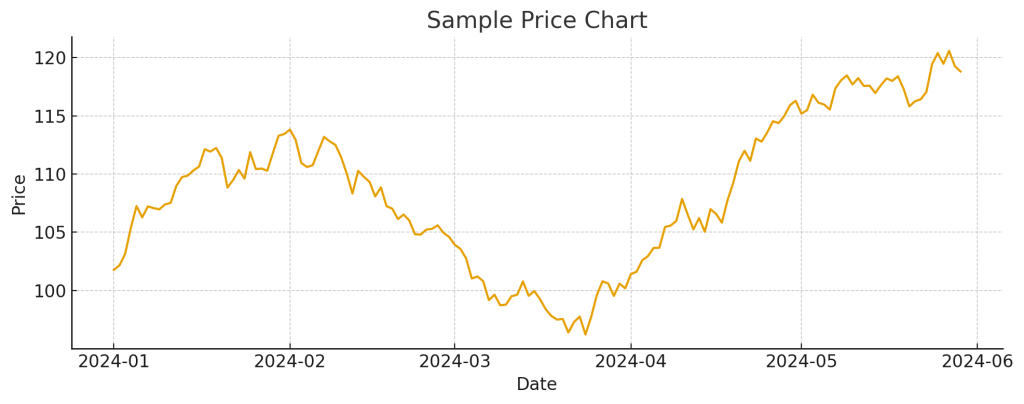
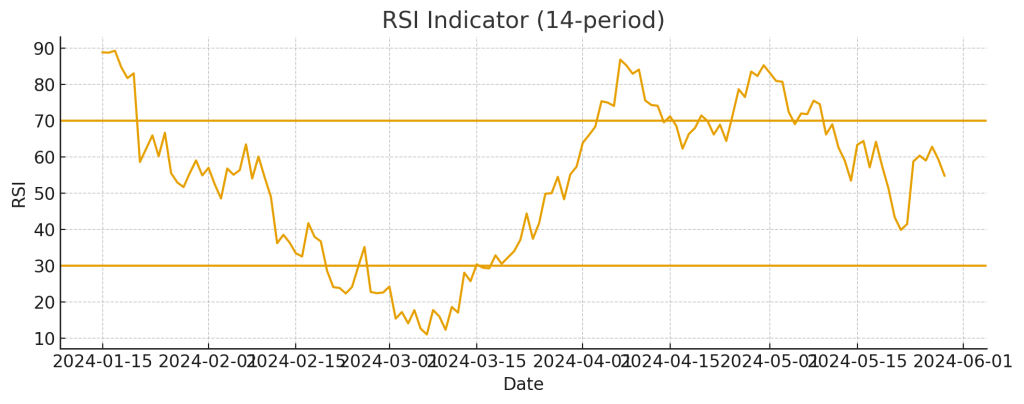
Example Chart Explanation

1. Price Chart

(shows the stock’s price movement over time.)

2. RSI Chart

(shows RSI oscillating between 0 and 100 with reference lines at 30 and 70.)

Overbought Example

When RSI rises above 70:

  • Momentum is strong but may be overstretched.
  • When RSI turns back below 70, the price often slows down or pulls back.

Oversold Example

When RSI falls below 30:

  • Indicates strong downside pressure.
  • When RSI rises above 30, price often stabilizes or rebounds.

How Traders Use RSI

  1. Entry Signal (Buy) : RSI crosses above 30 → possible buying opportunity.
  2. Exit Signal (Sell) : RSI crosses below 70 → possible selling signal.
  3. Trend Reversals (Divergence) Traders watch for differences between price movement and RSI movement:
    • Bullish Divergence:
      Price makes lower lows, but RSI makes higher lows.
      → Suggests a potential upward reversal.
      → Buy when RSI crosses above 30.
    • Bearish Divergence:
      Price makes higher highs, but RSI makes lower highs.
      → Suggests a potential downward reversal.
      → Sell when RSI crosses below 70.

Limitations

  • RSI can stay overbought or oversold for long periods during strong trends.
  • It may give false signals in sideways or choppy markets.
  • Works best when combined with price action, moving averages, MACD, or volume confirmation.

Conclusion

The RSI is a simple yet powerful indicator that helps traders understand momentum and identify potential turning points in the market. While it provides helpful signals for entries, exits, and trend reversals, it should not be used alone. Combining RSI with other technical tools and overall market context leads to more reliable and confident trading decisions.


Understanding Moving Averages in Trading

Moving Average (MA)

A moving average represents the average price of a security over a specific period, helping traders smooth out short-term price fluctuations and identify overall trends.

Types of Moving Averages

TypePeriod CoveredUsageTrend Focus
200-Day Moving Average (200-DMA)Last 200 trading daysLong-term trend identificationBroad market direction
50-Day Moving Average (50-DMA)Last 50 trading daysShort- to intermediate-term analysisRecent price momentum

How to Interpret a Moving Average

Golden Cross (Bullish Signal)

Definition:
Occurs when the 50-DMA crosses above the 200-DMA.

Interpretation:
→ Signals a bullish trend, indicating potential long-term upward momentum.
The crossover shows that short-term momentum is overtaking long-term averages, suggesting renewed market strength.

Confirmation:
Traders look for increasing trading volumes or other indicators (like RSI or MACD) to validate the uptrend.

Death Cross (Bearish Signal)

Definition:
Occurs when the 50-DMA crosses below the 200-DMA.

Interpretation:
→ Signals a bearish trend, indicating potential long-term downward momentum.
This suggests that short-term weakness is overtaking long-term support levels.

Confirmation:
Traders often seek validation through
• A break of key support levels
Declining trading volumes
• Other bearish indicators

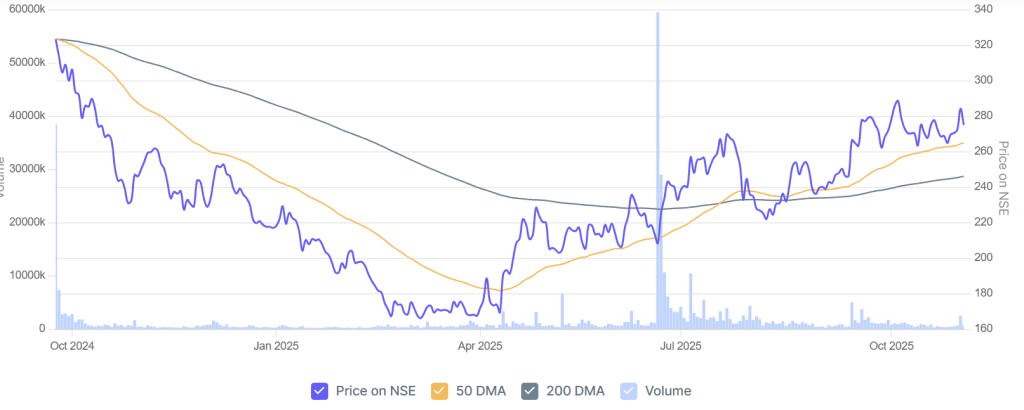
Example: Golden Cross – Northern ARC Capital Ltd

Northern ARC Capital Ltd (Chart source : https://www.screener.in)

In the chart above:

  • The blue line represents the price movement of the stock on NSE.
  • The orange line is the 50-Day Moving Average (50-DMA) — short- to mid-term trend indicator.
  • The grey line is the 200-Day Moving Average (200-DMA) — long-term trend indicator.
  • The light blue bars show the trading volume.

Observations

  1. October 2024 – March 2025:
    The stock remained in a downtrend, with the 50-DMA below the 200-DMA — a bearish phase. Prices continued to decline as momentum weakened.
  2. April – June 2025:
    The price started recovering, forming higher lows. The 50-DMA began to turn upward, indicating strengthening short-term momentum.
  3. June – July 2025: The Golden Cross
    The 50-DMA crossed above the 200-DMA, forming a Golden Cross — a bullish signal suggesting a potential long-term uptrend was beginning.
    This crossover was also supported by a spike in trading volume, adding credibility to the move.
  4. August – October 2025:
    After the crossover, prices continued to trend upward, confirming the bullish reversal.

Summary

  • A Moving Average helps visualize the trend by averaging prices over time.
  • The 50-DMA tracks short- to mid-term momentum, while the 200-DMA tracks long-term direction.
  • Golden Cross → Bullish trend may be forming.
  • Death Cross → Bearish trend may be developing.
  • Always confirm signals using other indicators (RSI, MACD, Volume) before making trading decisions.

Quick Insight: RSI and MACD

Relative Strength Index (RSI):
A momentum indicator that measures the speed and magnitude of price changes.

  • RSI ranges from 0 to 100
  • Above 70 → overbought (potential pullback)
  • Below 30 → oversold (potential rebound)

Moving Average Convergence Divergence (MACD):

A trend-following momentum indicator that shows the relationship between two moving averages of a stock’s price.

  • MACD line crossing above the Signal line → bullish signal
  • MACD line crossing below the Signal line → bearish signal

These indicators help traders confirm whether a Golden Cross or Death Cross is supported by momentum strength or weakness.

Your Turn

Have you ever used moving averages to identify entry or exit points in your trades?
What signals or confirmations do you rely on most — the crossover itself, volume trends, or other indicators?

Why Hyundai Motor India’s IPO Didn’t Attract Retail Investors?

Hyundai Motor India’s IPO, the largest in India’s history, was subscribed 2.37 times on the final day, mainly driven by qualified institutional buyers (QIBs). Retail and non-institutional investors showed significantly less enthusiasm, subscribing to only 50% and 60% of their allotted shares, respectively. This tepid response from retail investors can be attributed to several key factors:

  1. High Valuation: Although Hyundai’s price band was aligned with competitors like Maruti Suzuki, many retail investors found the pricing expensive, with little room for listing gains. The stock’s price-to-earnings ratio and overall valuation appeared unattractive, especially in the context of broader market uncertainty. This sentiment is reflected in the Hyundai IPO’s grey market premium (GMP), which initially made a high of ₹ 570 but dropped to ₹0 by 17th October. The sharp decline in GMP indicated fading expectations for immediate post-listing profits, further dampening enthusiasm among retail investors, who are often drawn to IPOs with short-term gains potential.
  2. Offer for Sale (OFS): Since the IPO was an offer for sale (OFS), it meant that the existing promoters were selling their stake rather than raising new capital for growth. Investors often prefer fresh issues that inject capital into the company for future expansion, which wasn’t the case here. The lack of fresh funds for growth-oriented initiatives could have contributed to the lukewarm reception.
  3. Market Volatility and Economic Concerns: Given the current economic uncertainties, including inflationary pressures, global slowdown concerns, and geopolitical issues, retail investors may have been hesitant to commit to new investments, especially in large-ticket IPOs.
  4. Automotive Industry Headwinds: While Hyundai maintains a strong market position, particularly in the SUV segment, the broader automotive industry is grappling with several challenges. Slowing sales, rising unsold inventory at dealerships, and increasing competition from electric vehicles (EVs) have created a cautious outlook. Moreover, long-term concerns over the future of internal combustion engine (ICE) vehicles amid growing regulatory and environmental pressures have added uncertainty to the industry’s trajectory. An example of this cautious sentiment comes from Bajaj Auto’s post-results earnings call, which highlighted the muted start to the festive season, traditionally a key period for auto sales in India. Bajaj Auto reported that sales growth during the festive season fell below expectations, with a projected increase of only 3-5%. Additionally, for the full fiscal year FY25, Bajaj Auto estimated domestic two-wheeler industry growth at a modest 5%, reflecting the headwinds the industry is facing. These broader sectoral struggles likely contributed to the cautious sentiment among retail investors in Hyundai’s IPO, as they weighed the risks of investing in a sector undergoing significant transformation.

In contrast, Qualified Institutional Buyers (QIBs) showed strong interest, subscribing heavily to the IPO. This reflects institutional confidence in Hyundai’s long-term potential, but retail investors appeared more focused on short-term risks and valuation concerns.