What is an Arbitrage Fund? Key Benefits and Risks Explained

Arbitrage Fund Overview

An arbitrage fund is a type of hybrid mutual fund that seeks to generate returns by exploiting price discrepancies of the same security in different markets (for example, between the cash/spot market and the futures market). They rely on arbitrage opportunities rather than directional bets on stock prices.


Advantages

  • Tax efficiency: Classified as equity-oriented mutual funds, so they enjoy lower tax rates compared to fixed deposits and most debt funds.
  • Relatively lower risk than equity funds: Returns are not driven by stock price appreciation but by arbitrage opportunities, making them less risky during volatile markets.
  • Good for short-term parking: Useful for investors who want to park money for a few months with lower risk and better post-tax returns than liquid/debt funds.

Disadvantages

  • Not suitable for long-term wealth creation: Returns are moderate (typically 4–7% p.a.), so they do not generate high capital appreciation like pure equity funds.
  • High expense ratio: Arbitrage opportunities require frequent trading, which leads to higher costs compared to debt or liquid funds.
  • Returns depend on volatility: If markets are stable with fewer arbitrage opportunities, returns may be lower.

Taxation (as Equity Fund)

  • Short-Term Capital Gains (STCG)
    • Holding Period: Less than 12 months.
    • Tax Rate: 20%.
    • Surcharge & Cess: Applicable on top of the 20% tax.
  • Long-Term Capital Gains (LTCG)
    • Holding Period: More than 12 months.
    • Tax Rate: 12.5%.
    • Exemption: The first ₹1.25 lakh of LTCG is tax-free annually.

Comparison: Arbitrage Fund vs Equity Fund vs Debt Fund vs FD:

FeatureArbitrage FundEquity FundDebt FundFixed Deposit (FD)
Nature of InvestmentHybrid (equity + derivatives)Pure equity (stocks)Bonds, govt. securities, corporate debtBank deposit
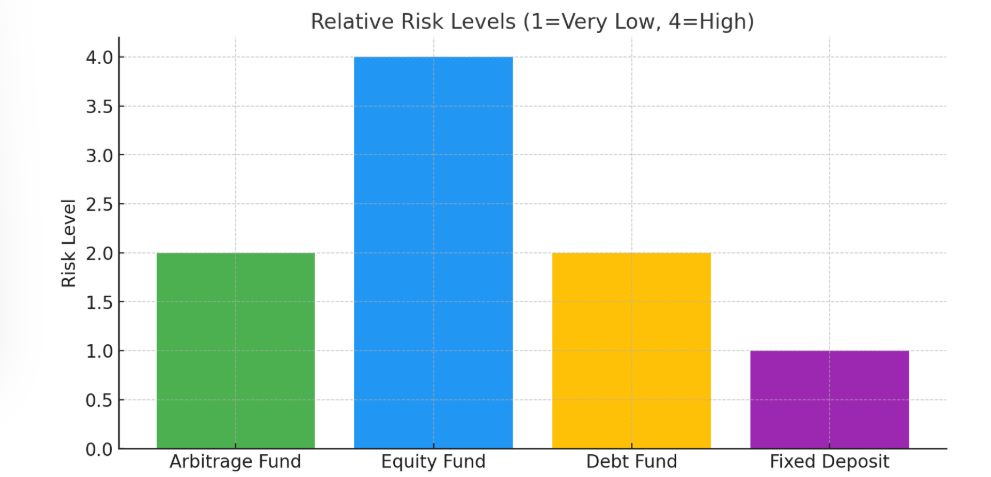
Risk LevelLow–ModerateHighLow–ModerateVery Low
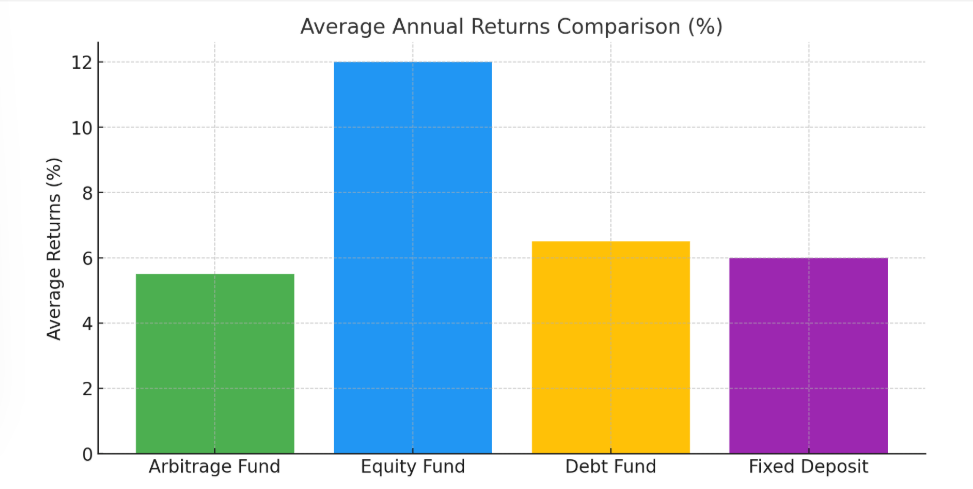
Return Potential4–7% (linked to arbitrage opportunities)High (10–15%+ in long term, but volatile)5–8% (depends on interest rate cycle)5–7% (fixed depending on tenor)
Best Use CaseShort-term parking of fundsLong-term wealth creationMedium-term income & stabilitySafe savings, capital protection
LiquidityHigh (T+1 or T+2 redemption)High (but market risk)HighMedium (premature withdrawal penalty)
Taxation – STCG20% (if held < 12 months)20% (if held < 12 months)taxed at income slabInterest taxed at income slab
Taxation – LTCG12.5% above ₹1.25 lakh (if held > 12 months)12.5% above ₹1.25 lakh (if held > 12 months)20% with indexation (if held > 3 yrs)No LTCG; interest always taxed
Safety of CapitalRelatively safe (but not guaranteed)Market dependentSafer than equity, but credit risk possibleGuaranteed by bank (up to ₹5 lakh insured per depositor)
Expense RatioHigh (due to frequent trades)ModerateLow–ModerateNone
Who Should Invest?Conservative investors seeking better-than-FD short-term returnsAggressive investors with long-term horizonConservative to moderate investors looking for stable returnsRisk-averse investors wanting fixed guaranteed income

Visual Comparisons

Average Returns Comparison (%)
Relative Risk Levels (1=Very Low, 4=High):
Summary:

  • Arbitrage Funds → Good for short-term (low-risk, tax-efficient).
  • Equity Funds → Best for long-term wealth creation.
  • Debt Funds → Balanced choice for medium-term safety + returns.
  • FDs → Safe but least tax-efficient.

In short: Arbitrage funds are low-risk, tax-efficient short-term options but not for long-term growth.

Impact of Interest Rate Changes on Bond Prices and Debt Fund Returns

Understanding the Inverse Relationship Between Bond Prices and Interest Rates

Bonds pay a fixed interest, known as the coupon rate. When market interest rates change, the value of existing bonds adjusts to align with newly issued bonds at the current rates, leading to an inverse relationship between bond prices and interest rates.

Impact of Interest Rate Movements on Bonds and Debt Funds

1. Rising Interest Rates:

  • Effect on Bonds: When interest rates rise, new bonds are issued with higher coupon rates (e.g., 6%). This makes existing bonds with lower coupon rates (e.g., 5%) less attractive. To compensate for the lower yield, the price of these bonds must fall to offer a comparable yield to new bonds.
  • Example:
    If you hold a bond with a face value of ₹1000 and a coupon rate of 5% (₹50 interest annually), when new bonds are issued at 6%, investors will demand a lower price for your bond. To match the 6% yield, the bond’s price must fall below ₹1000.
  • Effect on Debt Funds: Since the prices of existing bonds fall, the Net Asset Value (NAV) of debt mutual funds also decreases, resulting in lower returns.

2. Falling Interest Rates:

  • Effect on Bonds: When interest rates fall, new bonds are issued with lower coupon rates (e.g., 4%). Existing bonds with higher coupon rates (e.g., 5%) become more attractive, increasing their market value.
  • Example:
    If interest rates drop and new bonds are issued at 4%, your bond with a 5% coupon rate becomes more desirable. Investors would pay more than ₹1000 for your bond, boosting its price.
  • Effect on Debt Funds: The increase in bond prices leads to capital gains for bondholders, resulting in higher returns for debt mutual funds.

Investment Strategies for Managing Interest Rate Risk in Debt Funds

Rising Interest Rate Scenarios:

  • Short-Duration Funds:
    In a rising interest rate environment, short-duration bonds or debt funds are preferable. These bonds mature quickly, allowing reinvestment at higher rates without significant price depreciation.
    • Why? Short-term bonds are less sensitive to interest rate changes, reducing the impact of rising rates on bond prices.
    • Funds to Consider: Liquid funds, ultra-short-term bond funds.

Falling Interest Rate Scenarios:

  • Long-Duration Funds:
    Long-duration bonds gain the most during falling interest rates because their prices increase more with the decline in interest rates.
      • Why? Longer-duration bonds lock in higher coupon rates, and their prices rise as newer bonds are issued at lower rates.
      • Funds to Consider: Gilt funds, long-duration debt funds.
    • Dynamic Bond Funds:
      These funds adjust the portfolio’s duration based on the interest rate outlook. Fund managers switch between long and short-term bonds depending on market expectations, allowing investors to gain in both rising and falling interest rate environments.

    Other Strategies:

    • Fixed Maturity Plans (FMPs):
      FMPs lock in yields for a fixed term, offering stable returns. They may not be as attractive in a rising interest rate environment, but in stable or falling rate periods, they provide predictable returns, insulating investors from market fluctuations.

    Key Takeaways for Investors:

    • Monitor the Interest Rate Environment: Investors should keep an eye on interest rate trends to adjust their portfolio allocations accordingly.
    • In Rising Rate Scenarios: Focus on short-duration funds or strategies that reduce interest rate risk.
    • In Falling Rate Scenarios: Consider long-duration funds or dynamic bond funds to capture gains from rising bond prices.
    • Use FMPs for Stability: In stable or falling rate environments, FMPs offer predictable returns with lower risk.

    By following these strategies, investors can improve their returns while managing the risk associated with fluctuating interest rates in debt mutual funds.

    Understanding Exchange-Traded Funds (ETF): Advantages, Limitations, and Popular Uses

    What is Exchange-Traded Fund (ETF)?

    An Exchange-Traded Fund (ETF) is a type of investment fund that is traded on stock exchanges, much like stocks. ETFs are designed to track the performance of a specific index (such as the S&P 500), sector, commodity (like gold or silver or oil), or a collection of assets like stocks or bonds.

    Advantages of ETFs:

    1. Lower Costs: ETFs often have a lower expense ratio compared to actively managed mutual funds.
    2. Liquidity: They can be traded throughout the day on the stock exchange, allowing for quick buy and sell decisions.
    3. Diversification: Although a single ETF may focus on a specific sector, many ETFs offer broad exposure across different industries, asset classes, or regions.
    4. Exposure to Commodities: Investors can get exposure to commodities like gold, silver or oil without needing to physically hold the commodity.
    5. Ease of Trading:
      • Intraday Trading: ETFs combine the best of both stocks and mutual funds by allowing intraday trading, so investors can take advantage of market movements as they happen.
      • Real-Time Pricing: Unlike mutual funds, which are priced at the end of the day, ETF prices fluctuate throughout the day based on supply and demand.

    Limitations of ETFs:

    1. Concentration Risk: ETFs that track a specific sector, commodity, or a small number of securities may have concentrated exposure, which can increase risk if that area underperforms.
    2. Trading Costs:
      • Brokerage Fees: While ETFs have lower expense ratios, frequent trading can lead to significant brokerage fees, which can erode returns over time.
      • Bid-Ask Spread: The difference between the buying price (ask) and selling price (bid) can impact the overall cost, especially in less liquid ETFs.
    3. Intraday fluctuations: Due to intraday fluctuations, some trades may be carried out at higher price.

    ETFs are popular among both individual and institutional investors due to their flexibility, cost efficiency, and ease of access to diverse markets and assets. But, like all investments, they need careful consideration of their structure, associated costs, and the specific exposure they offer.

    Understanding Debt Mutual Funds: Risks and Benefits Explained

    A Common Investor Story

    Ramesh is a 45-year-old salaried professional. He doesn’t like the ups and downs of the stock market, but fixed deposits no longer give him the returns he wants. His bank relationship manager suggests debt mutual funds, calling them “safe,” “stable,” and “better than FDs.”

    Reassured by words like bonds, fixed income, and low risk, Ramesh invests a part of his savings in a debt mutual fund, expecting steady returns and easy liquidity.

    But is a debt mutual fund really risk-free?

    What Are Debt Mutual Funds?

    Debt mutual funds invest your money in instruments such as:

    • Government securities
    • Corporate bonds and debentures
    • Treasury bills and money market instruments

    These investments pay interest, which is why debt funds are often seen as safer and more predictable than equity mutual funds.


    Why Debt Mutual Funds Feel Safer Than Equity Funds

    1. Regular Income from Bonds

    Unlike shares, bonds promise interest payments and repayment of principal at maturity. This makes debt funds feel more secure than equity funds, where returns depend entirely on market prices.

    2. Lower Day-to-Day Fluctuations

    Debt fund NAVs usually move slowly compared to equity funds. This lower volatility attracts investors who want stability or are investing for short- to medium-term goals.


    The Risks Most Retail Investors Overlook

    Despite their conservative image, debt mutual funds carry risks that often surface only during difficult times.


    1. Credit Risk – When the Borrower Doesn’t Pay

    Credit risk arises when the company or institution that issued the bond fails to pay interest or return the principal.

    Why it matters:
    To earn higher returns, some debt funds invest in bonds issued by weaker or lower-rated companies. If such a borrower defaults, the fund’s value can fall sharply—sometimes overnight.

    Real-life reminder:
    In 2018, IL&FS, a company rated AAA, suddenly defaulted on its debt. Several debt mutual funds had exposure to its bonds and commercial paper. Investors who expected “safe” returns were shocked to see losses and write-downs. The event also triggered panic across NBFC and housing finance stocks, proving that credit risk can appear without warning.


    2. Interest Rate Risk – When Rates Move Against You

    Bond prices and interest rates move in opposite directions.

    What this means for you:

    • If interest rates rise, existing bonds lose value, pulling down the fund’s NAV.
    • If interest rates fall, bond prices rise, benefiting the fund’s NAV.

    Debt funds that hold long-term bonds are more sensitive to interest rate changes and can show noticeable ups and downs, even without any default.


    3. Liquidity Risk – Getting Your Money When You Need It

    Liquidity risk occurs when many investors try to exit the fund at the same time.

    What can go wrong:
    During market stress, a fund may struggle to sell its bonds quickly. This can force the fund to sell at poor prices or, in extreme cases, restrict withdrawals—something many retail investors assume can never happen.


    What This Means for Investors Like Ramesh

    Debt mutual funds are not the same as fixed deposits. They:

    • Do not guarantee returns
    • Can fall in value
    • Are exposed to market events and credit quality

    They can be useful tools—but only when chosen carefully and matched to the right goal and time horizon.


    A Practical Investment Tip for Retail Investors

    Before investing in any debt mutual fund, look at the monthly fact sheet. Focus on:

    • How much of the portfolio is in AAA-rated bonds
    • Exposure to lower-rated or unrated instruments
    • Average maturity and duration compared to the benchmark

    If the fund is taking extra credit risk to show higher returns, make sure you are comfortable with that risk.


    Understanding Index Funds: Advantages, Disadvantages and Suitability

    What are Index funds?

    Index funds are mutual funds or exchange-traded funds (ETFs) designed to replicate the performance of a specific market index, such as the S&P 500, Nifty 50, or S&P BSE Sensex. They follow passive investment strategy, meaning they do not require frequent trading or active management.

    The goal of an index fund is to match the returns of the index it tracks by holding all or a representative sample of the securities in that index.

    John Bogle, Vanguard founder, is credited with pioneering the concept of Index funds by creating the first-ever index fund Vanguard 500 fund in 1976. This fund was designed to passively track the returns of the S&P 500, an index representing the 500 largest publicly traded companies in the U.S. His innovation democratized investing, particularly in an era dominated by costly brokerage services, and shifted the focus toward long-term growth over short-term trading. This strategy has had a profound and lasting impact on the investment landscape.

    Advantages of Index Funds:

    1. Low Expense Ratios: Since index funds follow a passive investing approach, they tend to have lower management fees compared to actively managed funds. This is because they do not require portfolio managers to make decisions about which securities to buy and sell.
    2. Diversified Portfolio: By tracking an index, these funds automatically spread investments across a large number of securities (stocks or bonds), which helps reduce the risk associated with investing in individual securities.
    3. Simplicity: Index funds are straightforward and easy to understand for most investors. The goal is simply to match the performance of the index, and no active management decisions are needed.
    4. Lower Turnover: Because the funds only buy or sell securities when the composition of the index changes, they tend to have lower transaction costs and capital gains taxes.

    Disadvantages of Index Funds:

    1. No Flexibility in Portfolio Management: Index funds follow a rigid structure by adhering to the composition of the index, leaving no room for managers to make decisions to potentially outperform the market.
    2. Market Downturns: Index funds offer no protection from overall market declines. Since they are designed to mirror the index, if the market goes down, the fund’s value will decrease as well.
    3. Average Returns: Since index funds are designed to match the market, they will typically offer average returns compared to the market as a whole. Index funds will not suit investors looking for above-market returns .

    In summary, index funds are suitable for investors seeking a low-cost, diversified, and long-term investment strategy that tracks the broader market’s performance. They are ideal for investors who prefer not to engage in active trading and market timing.

    Understanding Mutual Funds: Advantages, Disadvantages, and Considerations

    Mutual Funds: An Ideal Passive Investment Option for Investors

    For individuals who lack expertise in analyzing stocks, understanding financial statements, or simply don’t have the time to conduct in-depth research into individual investments, mutual funds offer an accessible and relatively stress-free investment avenue. Mutual funds provide a way to enter the market with the guidance of professional fund managers and a diversified portfolio that helps mitigate some of the inherent risks of investing.

    What are mutual funds?

    Mutual funds pool together capital from multiple investors, which is then managed by professional fund managers. These managers allocate the pooled funds into a diversified portfolio, which may include a mix of stocks, bonds, money market instruments, and other assets, depending on the specific objectives of the mutual fund. The fund’s performance, therefore, reflects the performance of the assets it invests in, and each investor shares in the gains or losses proportionally based on their investment.

    Advantages of Investing in Mutual Funds:

    1. Diversification:
      Mutual funds inherently offer diversification, which reduces risk by spreading investments across a range of assets such as different stocks, industries, or even asset classes like bonds. This diversification helps shield investors from the full impact of losses in any one particular asset or sector.
    2. Professional Management:
      One of the most significant advantages of mutual funds is that the investment decisions are made by professional fund managers who have experience and expertise in the market. These managers continuously monitor the portfolio and make adjustments based on market conditions, ensuring that the fund’s objectives are met.
    3. Flexibility of Investment Amounts:
      Mutual funds provide flexibility for investors to contribute based on their financial capacity. One can either invest a lump sum or choose a Systematic Investment Plan (SIP) where a fixed amount is invested at regular intervals (e.g., monthly or quarterly). This makes mutual funds accessible to investors with different income levels.
    4. Systematic Investment Planning (SIP):
      SIPs allow investors to invest regularly in small amounts rather than making a large one-time investment. This not only makes investing more manageable for those on a budget but also helps investors take advantage of cost averaging. By investing regularly over time, investors can average the cost of their investments, especially in a volatile market.
    5. Tailored to Risk Appetite:
      Mutual funds cater to a wide range of risk appetites, from conservative investors looking for capital preservation in low-risk debt funds to aggressive investors seeking higher returns in equity funds. Investors can choose mutual funds based on their risk tolerance, financial goals, and investment horizon.

    Disadvantages of Mutual Funds:

    1. Costs and Fees:
      Mutual funds charge management fees to cover the costs of running the fund. These fees include the remuneration of the fund manager, administrative expenses, and other operational costs. These expenses, known as the expense ratio, are deducted from the fund’s returns, which can reduce the overall return on investment (profit), particularly in actively managed funds.
    2. Lack of Control:
      Investors in mutual funds do not have control over the individual stocks or bonds that the fund invests in. All investment decisions are made by the fund manager. While this can be advantageous for those who prefer professional management, some investors might feel uneasy about not having a say in which assets the fund invests in.
    3. Market Risk:
      Like all market-linked investments, mutual funds are subject to market risks. The value of the mutual fund can fluctuate based on the performance of the underlying assets. While diversification can reduce risk, it cannot eliminate it entirely, and investors can still experience losses, particularly in periods of market downturns or crash.
    4. Limited Transparency:
      Although mutual funds are required to disclose their holdings, they do so at periodic intervals (usually monthly or quarterly). As a result, investors may not always have real-time information about the specific securities in the fund’s portfolio.
    5. Potential for Over-Diversification:
      While diversification reduces risk, excessive diversification can dilute returns. If a mutual fund is too broadly diversified, the strong performance of a few assets may not significantly impact the overall fund performance. This can lead to lower returns, especially in equity funds.

    Overall, mutual funds are an appealing option for investors seeking a hands-off approach with a built-in safety net of diversification and professional oversight. However, investors should be aware of the associated costs and risks, as well as their lack of control over individual investment decisions. As with any investment, it’s important to choose mutual funds that align with your financial goals, risk tolerance, and investment time horizon.