Rethinking the Rule of 100: A Modern Approach to Investment Risk

Rethinking the Rule of 100

A Story to Begin With

Two investors walk into the same financial planning office.

The first is 28 years old, earning a decent salary but juggling a home loan, car EMI, and plans for a child’s education. The second is 62, recently retired, debt-free, with accumulated savings and a steady pension.

According to the Rule of 100, the younger investor should aggressively invest in equities, while the older one should sharply reduce stock exposure. But when you look at their real financial lives, the picture feels counterintuitive. The younger investor cannot afford large losses, while the retired investor may actually have the stability to ride out market volatility.

This disconnect raises an important question:
Should age alone determine how much investment risk you take?

That question sits at the heart of this article.


The Rule of 100 – Asset Allocation by Age

When it comes to investing, one of the most common questions people ask is:
How much should I invest in equities and how much in safer assets?

To simplify this decision, financial planners have long relied on age-based formulas—the most popular being the Rule of 100.

At first glance, the rule seems logical and easy to follow. But does it truly reflect how real people earn, save, and spend today? Let’s take a closer look.


What Is the Rule of 100?

The Rule of 100 is a basic guideline used to determine asset allocation based on age.

Formula:
100 − Your Age = Percentage of your portfolio invested in equities

The remaining portion is allocated to bonds, debt instruments, or other relatively low-risk assets.

Simple Examples

  • Age 30
    • 70% in stocks
    • 30% in bonds/debt
  • Age 50
    • 50% in stocks
    • 50% in bonds/debt

The Logic Behind the Rule

The rule is built on a straightforward assumption:
risk tolerance declines with age.

Younger investors are expected to have:

  • Longer investment horizons
  • More time to recover from market downturns

Older investors, on the other hand, are assumed to:

  • Prefer stability over growth
  • Focus on capital preservation and steady income

This thinking made sense decades ago—but markets, careers, and lifespans have changed.


Why the Rule Evolved: Rule of 110 and Rule of 120

As life expectancy increased and inflation became a bigger threat, financial advisors began adjusting the formula.

Rule of 110

110 − Age = Equity allocation

  • Age 30 → 80% equities
  • Age 50 → 60% equities

This version recognizes that:

  • People are working longer
  • Retirement needs are larger
  • Equity growth is crucial to beat inflation

Rule of 120

120 − Age = Equity allocation

  • Age 30 → 90% equities
  • Age 50 → 70% equities

This rule is typically suggested for investors with higher risk tolerance or those relying heavily on equity markets for long-term wealth creation.

A comparison of Rule of 100 vs Rule of 110 vs Rule of 120 is shown in the chart below:
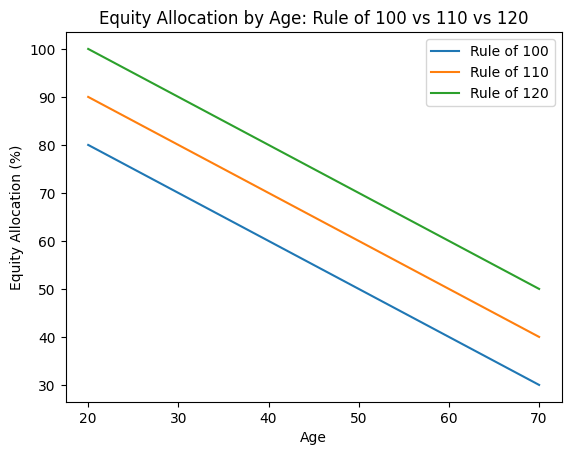
What the Chart Shows

  • X-axis: Investor age
  • Y-axis: Suggested equity allocation (%)

Three declining lines represent:

  • Rule of 100 (most conservative)
  • Rule of 110 (moderate)
  • Rule of 120 (most aggressive)

Key Takeaways:

  • All three rules reduce equity exposure linearly with age
  • The difference between rules becomes more pronounced at younger ages
  • Even at age 60–70, Rule of 120 still suggests meaningful equity exposure, reinforcing the inflation-risk argument

The Big Problem With All These Rules

Despite their popularity, the Rule of 100, 110, and 120 share one major flaw:

They assume age alone determines risk capacity.

In reality, age tells only part of the story.


A Contrarian Perspective: When the Rule Breaks Down

Younger Investors Aren’t Always Risk-Takers

Many young investors face:

  • Lower incomes and limited savings
  • Home loans, car EMIs, and education expenses
  • Small emergency buffers

For them, a sharp market fall can cause real financial stress. Even though time is on their side, their ability to absorb losses may be limited. In such cases, aggressive equity exposure can do more harm than good.

Older Investors May Have Higher Risk Capacity

Ironically, many older or retired investors:

  • Are free from major financial obligations
  • Have accumulated wealth, pensions, or rental income
  • Can emotionally handle short-term volatility

For them, maintaining meaningful equity exposure may actually be necessary to protect purchasing power against inflation.


The Real Question: Risk Tolerance or Risk Capacity?

This is where most age-based rules fall short.

  • Risk tolerance is how comfortable you feel with volatility
  • Risk capacity is whether your finances can survive a downturn

Risk capacity depends far more on:

  • Cash flows
  • Liabilities
  • Financial security
  • Emergency reserves

—not just your age.


Final Thoughts

The Rule of 100 and its modern variations are useful starting points, not formulas to follow blindly.

Smart asset allocation requires balancing:

  • Age
  • Income stability
  • Financial responsibilities
  • Long-term goals
  • The ability—not just the willingness—to take risk

In investing, simplicity helps.
But context matters even more.


What Do You Think?

  • Should age alone determine how much risk an investor takes?
  • Have your financial responsibilities increased or reduced your ability to invest in equities?
  • For younger investors with EMIs, is aggressive equity allocation practical—or risky?
  • Should retired investors reduce equity exposure simply because of age?
  • Which matters more: risk tolerance or risk capacity?
  • Do you follow the Rule of 100 (or 110/120), or have you created your own approach?

👉 Share your views—your experience may help others rethink how they invest.

What is an Arbitrage Fund? Key Benefits and Risks Explained

Arbitrage Fund Overview

An arbitrage fund is a type of hybrid mutual fund that seeks to generate returns by exploiting price discrepancies of the same security in different markets (for example, between the cash/spot market and the futures market). They rely on arbitrage opportunities rather than directional bets on stock prices.


Advantages

  • Tax efficiency: Classified as equity-oriented mutual funds, so they enjoy lower tax rates compared to fixed deposits and most debt funds.
  • Relatively lower risk than equity funds: Returns are not driven by stock price appreciation but by arbitrage opportunities, making them less risky during volatile markets.
  • Good for short-term parking: Useful for investors who want to park money for a few months with lower risk and better post-tax returns than liquid/debt funds.

Disadvantages

  • Not suitable for long-term wealth creation: Returns are moderate (typically 4–7% p.a.), so they do not generate high capital appreciation like pure equity funds.
  • High expense ratio: Arbitrage opportunities require frequent trading, which leads to higher costs compared to debt or liquid funds.
  • Returns depend on volatility: If markets are stable with fewer arbitrage opportunities, returns may be lower.

Taxation (as Equity Fund)

  • Short-Term Capital Gains (STCG)
    • Holding Period: Less than 12 months.
    • Tax Rate: 20%.
    • Surcharge & Cess: Applicable on top of the 20% tax.
  • Long-Term Capital Gains (LTCG)
    • Holding Period: More than 12 months.
    • Tax Rate: 12.5%.
    • Exemption: The first ₹1.25 lakh of LTCG is tax-free annually.

Comparison: Arbitrage Fund vs Equity Fund vs Debt Fund vs FD:

FeatureArbitrage FundEquity FundDebt FundFixed Deposit (FD)
Nature of InvestmentHybrid (equity + derivatives)Pure equity (stocks)Bonds, govt. securities, corporate debtBank deposit
Risk LevelLow–ModerateHighLow–ModerateVery Low
Return Potential4–7% (linked to arbitrage opportunities)High (10–15%+ in long term, but volatile)5–8% (depends on interest rate cycle)5–7% (fixed depending on tenor)
Best Use CaseShort-term parking of fundsLong-term wealth creationMedium-term income & stabilitySafe savings, capital protection
LiquidityHigh (T+1 or T+2 redemption)High (but market risk)HighMedium (premature withdrawal penalty)
Taxation – STCG20% (if held < 12 months)20% (if held < 12 months)taxed at income slabInterest taxed at income slab
Taxation – LTCG12.5% above ₹1.25 lakh (if held > 12 months)12.5% above ₹1.25 lakh (if held > 12 months)20% with indexation (if held > 3 yrs)No LTCG; interest always taxed
Safety of CapitalRelatively safe (but not guaranteed)Market dependentSafer than equity, but credit risk possibleGuaranteed by bank (up to ₹5 lakh insured per depositor)
Expense RatioHigh (due to frequent trades)ModerateLow–ModerateNone
Who Should Invest?Conservative investors seeking better-than-FD short-term returnsAggressive investors with long-term horizonConservative to moderate investors looking for stable returnsRisk-averse investors wanting fixed guaranteed income

Visual Comparisons

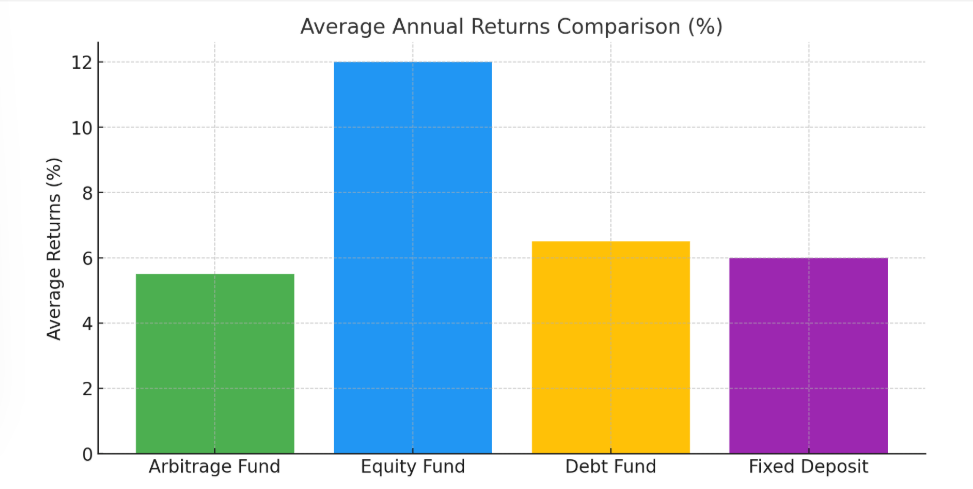
Average Returns Comparison (%)

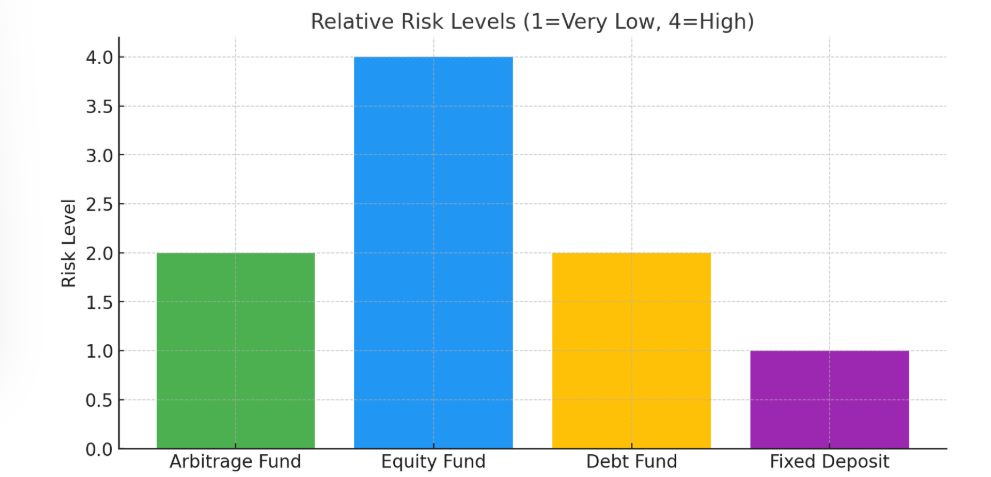
Relative Risk Levels (1=Very Low, 4=High):

Summary:

  • Arbitrage Funds → Good for short-term (low-risk, tax-efficient).
  • Equity Funds → Best for long-term wealth creation.
  • Debt Funds → Balanced choice for medium-term safety + returns.
  • FDs → Safe but least tax-efficient.

In short: Arbitrage funds are low-risk, tax-efficient short-term options but not for long-term growth.

Understanding Asset Allocation for Investors

One of the key component of investment strategy for investors is allocation of their capital over various asset classes. Understanding of asset classes is important for allocation of capital as each asset class comes with it’s unique characteristics, risks, and potential returns.

Overview of Asset Classes:

  1. Equities (Stocks):
    • Represent ownership in a company.
    • Typically offer higher risk and reward (returns).
  2. Fixed Income Securities (Bonds):
    • Debt instruments where investors lend money to corporations or governments in exchange for periodic interest payments.
    • Generally offer lower risk and lower returns than equities .
    • Provide regular income, making them suitable for more conservative investors or those seeking stable income.
  3. Commodities:
    • Physical assets such as gold, oil, agricultural products, and metals.
    • Tend to act as a hedge against inflation and provide portfolio diversification.
    • Prices can be volatile due to supply and demand dynamics, geopolitical events, and economic factors.
  4. Cash and Cash Equivalents:
    • Include savings accounts, Treasury bills, money market funds, and short-term government bonds.
    • Highly liquid and low-risk, but offer lower returns, often below inflation rates.
    • Serve as a safe haven for capital preservation and short-term liquidity needs.
  5. Real Estate:
    • Investment in property such as land, residential, or commercial buildings.
    • Provides potential for steady income through rent and long-term appreciation in property value.
    • Can act as a hedge against inflation but may involve high initial costs, illiquidity, and location-specific risks.

Key takeaways on asset allocation:

  1. Equities:
    • High risk, high reward, and growth-oriented. Suitable for long-term capital appreciation but subject to market volatility.
  2. Fixed Income Securities (Bonds):
    • Lower risk, lower returns, and a source of regular income. Bonds act as a stabilizing force, especially in volatile markets. Sensitive to interest rate fluctuations.
  3. Commodities:
    • Provide diversification and inflation protection. Their prices are influenced by forces of global supply, demand, and geopolitical factors, offering opportunities in times of economic uncertainty. They often perform well when other asset classes (like equities) are underperforming, especially during inflationary periods. For example, gold typically rises during economic uncertainty or currency devaluation.
  4. Cash and Cash Equivalents:
    • Highly liquid and low-risk, but with minimal returns. Best used for short-term needs and as a liquidity cushion. Overexposure can lead to erosion of purchasing power over time because of inflation.
  5. Real Estate:
    • Offers income through rent and the potential for appreciation. However, it carries risks like illiquidity and regional market volatility. REITs offer a more liquid way to gain exposure to real estate markets.

Asset Allocation Strategies:

  • Conservative Investors: Focus on stability and capital preservation. They prioritize bonds, cash, and conservative assets like real estate and gold.
  • Aggressive Investors: Aim for long-term growth, accepting short-term volatility. They tend to favor equities, commodities, and higher-risk real estate investments.
  • Moderate Investors: Strive for a balanced portfolio, mixing equities and bonds, with smaller allocations to real estate and commodities to manage risk and achieve steady growth.

Dynamic Asset Allocation:

Asset allocation is not static. It evolves based on changes in an investor’s life stage, goals, or market conditions. Younger investors, with a longer investment horizon, tend to favor equities, while those nearing retirement may shift towards fixed-income assets to ensure stability and income generation. Rebalancing portfolios over time ensures the asset mix aligns with changing risk tolerance and financial goals.

Final Thoughts:

An optimal asset allocation strategy allows investors to balance risk and reward effectively, while adjusting to market shifts and personal financial goals. Periodic review and rebalancing ensures that portfolios continue to meet the needs of investors at different stages of their financial journey.