Understanding Index Funds: Advantages, Disadvantages and Suitability

What are Index funds?

Index funds are mutual funds or exchange-traded funds (ETFs) designed to replicate the performance of a specific market index, such as the S&P 500, Nifty 50, or S&P BSE Sensex. They follow passive investment strategy, meaning they do not require frequent trading or active management.

The goal of an index fund is to match the returns of the index it tracks by holding all or a representative sample of the securities in that index.

John Bogle, Vanguard founder, is credited with pioneering the concept of Index funds by creating the first-ever index fund Vanguard 500 fund in 1976. This fund was designed to passively track the returns of the S&P 500, an index representing the 500 largest publicly traded companies in the U.S. His innovation democratized investing, particularly in an era dominated by costly brokerage services, and shifted the focus toward long-term growth over short-term trading. This strategy has had a profound and lasting impact on the investment landscape.

Advantages of Index Funds:

  1. Low Expense Ratios: Since index funds follow a passive investing approach, they tend to have lower management fees compared to actively managed funds. This is because they do not require portfolio managers to make decisions about which securities to buy and sell.
  2. Diversified Portfolio: By tracking an index, these funds automatically spread investments across a large number of securities (stocks or bonds), which helps reduce the risk associated with investing in individual securities.
  3. Simplicity: Index funds are straightforward and easy to understand for most investors. The goal is simply to match the performance of the index, and no active management decisions are needed.
  4. Lower Turnover: Because the funds only buy or sell securities when the composition of the index changes, they tend to have lower transaction costs and capital gains taxes.

Disadvantages of Index Funds:

  1. No Flexibility in Portfolio Management: Index funds follow a rigid structure by adhering to the composition of the index, leaving no room for managers to make decisions to potentially outperform the market.
  2. Market Downturns: Index funds offer no protection from overall market declines. Since they are designed to mirror the index, if the market goes down, the fund’s value will decrease as well.
  3. Average Returns: Since index funds are designed to match the market, they will typically offer average returns compared to the market as a whole. Index funds will not suit investors looking for above-market returns .

In summary, index funds are suitable for investors seeking a low-cost, diversified, and long-term investment strategy that tracks the broader market’s performance. They are ideal for investors who prefer not to engage in active trading and market timing.
Understanding Mutual Funds: Advantages, Disadvantages, and Considerations

Mutual Funds: An Ideal Passive Investment Option for Investors

For individuals who lack expertise in analyzing stocks, understanding financial statements, or simply don’t have the time to conduct in-depth research into individual investments, mutual funds offer an accessible and relatively stress-free investment avenue. Mutual funds provide a way to enter the market with the guidance of professional fund managers and a diversified portfolio that helps mitigate some of the inherent risks of investing.

What are mutual funds?

Mutual funds pool together capital from multiple investors, which is then managed by professional fund managers. These managers allocate the pooled funds into a diversified portfolio, which may include a mix of stocks, bonds, money market instruments, and other assets, depending on the specific objectives of the mutual fund. The fund’s performance, therefore, reflects the performance of the assets it invests in, and each investor shares in the gains or losses proportionally based on their investment.

Advantages of Investing in Mutual Funds:

  1. Diversification:
    Mutual funds inherently offer diversification, which reduces risk by spreading investments across a range of assets such as different stocks, industries, or even asset classes like bonds. This diversification helps shield investors from the full impact of losses in any one particular asset or sector.
  2. Professional Management:
    One of the most significant advantages of mutual funds is that the investment decisions are made by professional fund managers who have experience and expertise in the market. These managers continuously monitor the portfolio and make adjustments based on market conditions, ensuring that the fund’s objectives are met.
  3. Flexibility of Investment Amounts:
    Mutual funds provide flexibility for investors to contribute based on their financial capacity. One can either invest a lump sum or choose a Systematic Investment Plan (SIP) where a fixed amount is invested at regular intervals (e.g., monthly or quarterly). This makes mutual funds accessible to investors with different income levels.
  4. Systematic Investment Planning (SIP):
    SIPs allow investors to invest regularly in small amounts rather than making a large one-time investment. This not only makes investing more manageable for those on a budget but also helps investors take advantage of cost averaging. By investing regularly over time, investors can average the cost of their investments, especially in a volatile market.
  5. Tailored to Risk Appetite:
    Mutual funds cater to a wide range of risk appetites, from conservative investors looking for capital preservation in low-risk debt funds to aggressive investors seeking higher returns in equity funds. Investors can choose mutual funds based on their risk tolerance, financial goals, and investment horizon.

Disadvantages of Mutual Funds:

  1. Costs and Fees:
    Mutual funds charge management fees to cover the costs of running the fund. These fees include the remuneration of the fund manager, administrative expenses, and other operational costs. These expenses, known as the expense ratio, are deducted from the fund’s returns, which can reduce the overall return on investment (profit), particularly in actively managed funds.
  2. Lack of Control:
    Investors in mutual funds do not have control over the individual stocks or bonds that the fund invests in. All investment decisions are made by the fund manager. While this can be advantageous for those who prefer professional management, some investors might feel uneasy about not having a say in which assets the fund invests in.
  3. Market Risk:
    Like all market-linked investments, mutual funds are subject to market risks. The value of the mutual fund can fluctuate based on the performance of the underlying assets. While diversification can reduce risk, it cannot eliminate it entirely, and investors can still experience losses, particularly in periods of market downturns or crash.
  4. Limited Transparency:
    Although mutual funds are required to disclose their holdings, they do so at periodic intervals (usually monthly or quarterly). As a result, investors may not always have real-time information about the specific securities in the fund’s portfolio.
  5. Potential for Over-Diversification:
    While diversification reduces risk, excessive diversification can dilute returns. If a mutual fund is too broadly diversified, the strong performance of a few assets may not significantly impact the overall fund performance. This can lead to lower returns, especially in equity funds.

Overall, mutual funds are an appealing option for investors seeking a hands-off approach with a built-in safety net of diversification and professional oversight. However, investors should be aware of the associated costs and risks, as well as their lack of control over individual investment decisions. As with any investment, it’s important to choose mutual funds that align with your financial goals, risk tolerance, and investment time horizon.

Effective Interest Rate

Effective Interest Rate (EIR) is an important tool to understand your actual return on investment against a stated annual interest rate (also known as the nominal rate) and it can be different from stated interest rate due to the effect of compounding.

It’s fascinating how the stated annual interest rate can differ from the actual return due to compounding. The Effective Interest Rate (EIR) or Annual Equivalent Rate (AER) takes into account the impact of compounding periods, which can lead to a higher return than the nominal rate suggests.

When interest compounds more frequently than annually—like monthly or quarterly—the actual return on your investment increases. The EIR provides a clearer picture of this, showing how much interest you’ll effectively earn in a year considering the frequency of compounding.

For instance, if your bank manager says you’re getting a 10% return compounded monthly, the EIR will be higher than 10% because interest is being added to your balance each month, and you then earn interest on the interest.

Formula

Effective Interest Rate = (1+i/n)^n-1

Where

i = stated interest rate

n = Number of compounding periods

Example:

Bank is offering interest @ 10% compounded monthly on an investment of $ 1000.

Required: Calculate Effective Interest Rate

Effective Interest Rate = [(1+10%/12)^12]-1 = 10.47%

Let’s verify this will actual calculation table below:

Month Opening Balance ($)Monthly Interest @ 10% Closing Balance ($)
110008.31008.3
21008.38.41016.7
31016.78.51025.2
41025.28.51033.8
51033.88.61042.4
61042.48.71051.1
71051.18.81059.8
81059.88.81068.6
91068.68.91077.5
101077.591086.5
111086.59.11095.6
121095.69.11104.7
Total Interest104.7
Interest compounded monthly @ 10%

It is evident that actual return is 10.47% with interest of $104.7 on monthly compounding against the stated interest rate of 10%.

Diluted Earnings per share

Contents:

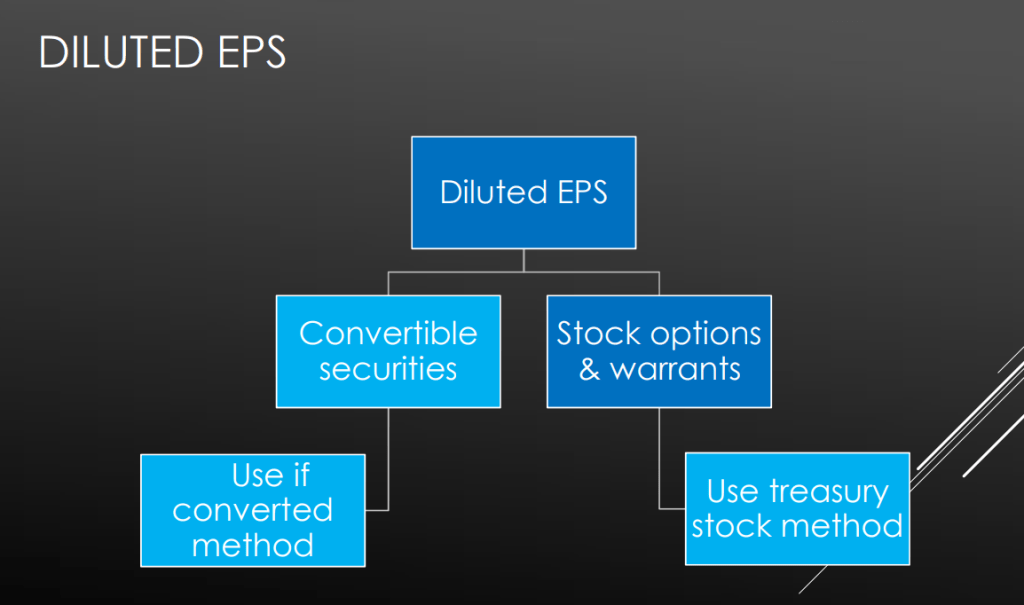
  1. Diluted EPS
  2. Calculation of Diluted EPS
    • Diluted EPS using if converted method
    • Diluted EPS using Treasury stock method
  3. Antidilutive security

Diluted EPS

Diluted EPS reflects the effect of all the company’s securities whose conversion / exercise would result in a dilution (reduction) of basic EPS.

Dilutive securities includes:

  1. convertible debt,
  2. convertible preferred shares,
  3. warrants,
  4. Options
  5. Employee stock options

Calculation of Diluted EPS

Diluted EPS =

(Net income available for common stockholders + Income adjustments due to dilutive financial instruments) / (Weighted average number of shares outstanding + Newly issuable shares due to dilutive financial instruments)

Diluted EPS on Convertible Preference shares using if converted method:

The conversion of preference shares has two effects on diluted EPS formula:

  1. Increase in denominator of outstanding shares on conversion of preference shares
  2. Increase in the numerator (Net income available for common stockholders) by dividends on convertible preferred stock.

Let’s understand this with the help of below example:

Net income$11,800
Ordinary shares 5,000 shares outstanding
Preferred shares ($2 dividend per share each year)
900 shares outstanding convertible into 2 ordinary shares
Total Preference dividends for the year $1,800
Basic EPS ($11,800 − $1,800) / 5,000 $2.00

Adjusted net income attributable to ordinary shareholders =

=11,800 + 1,800 ( Preference shares dividend no longer payable on conversion)

= $13,600

Number of shares outstanding on conversion of preference shares = 2000+ 1,800 = 3,800

Diluted EPS = 13,600 / 3,800 = $3.58 per share

Diluted EPS on Stock options using Treasury stock method

An option or warrant gives the holder the right to buy shares at some time in the future at a predetermined price.

Treasury-stock method assumes that proceeds received on exercise of the options is used to buy back shares at the average market price.

To calculate diluted EPS with an option, you need to work out the number of ‘free’ shares that will be issued if the options are exercised, and add that to the weighted average number of shares

Diluted EPS is calculated as if the financial instruments had been exercised and the company had used the proceeds from exercise to repurchase shares of common stock at the average market price of common stock during the period.

The weighted average number of shares outstanding for diluted EPS is thus increased by the number of shares that would be issued upon exercise net of the number of shares that would have been purchased with the proceeds.

We will understand this with the help of below example:

Net income$12,000
Ordinary shares shares outstanding2,000
Basic EPS ($12,000) / 2,000) $6
Stock options (200 options with exercise
price of $80), 200 shares to be issued on exercise
Average market price per ordinary share during
the year
$100

Proceeds from exercise of options = 200 x $ 80 = $ 16,000

No. of shares purchased from proceeds of exercise =$ 16,000 / 100 (average market price) =160 shares

Total number of shares outstanding = 2000 + 200 – 160 = 2040 shares

Diluted EPS = 12,000/2,040 shares = $5.88

Antidilutive security

Antidilutive security is a potentially convertible securities whose inclusion in the computation results in an increase in EPS than the basic EPS or a reduction in loss per share.

Under IFRS and US GAAP, antidilutive securities are not included in the calculation of diluted EPS.

Summary

Diluted EPS is an important metric for investors to know how much will be the potential dilution in earning per share if all convertible securities were exercised.

Related articles:

What is Earning per share (EPS)

What is PE Ratio?

How Compound interest  works to grow wealth?

My wealth has come from a combination of living in America, some lucky genes, and compound interest

– Warren Buffett

Compound interest means interest on interest. It is the result of reinvesting interest, rather than taking it out.

To understand the concept, let us assume $10,000 is invested @ 5% interest which is withdrawn at the end of each year. Total simple interest earned will be $ 1500 at the end of 3 years

YearPrincipalInterest @ 5% p.a.
110,000500
210,000500
310,000500
Total interest1500
Table 1: Simple interest

Let us assume $10,000 is invested @ 5% interest which is reinvested at the end of each year. This means at the end of year 1, interest earned $ 500 will be added to $ 10,000 principal and interest will be calculated for year 2 on $ 10,500 amounting to $ 525. Total cumulative interest earned will be $ 1576 at the end of 3 years

YearPrincipalInterest @ 5% p.a.
110,000500
210,500 (10000+500)525
311025 (10500+525)551
Total interest 1576
Table 2: Compound interest

We can see that compound interest results in interest of $1576 at the end of 3 years compared to simple interest of $ 1500, i.e. an extra interest of $ 76 by just keeping interest reinvested.

One can see, how power of compounding can help grow your wealth much faster.