Understanding ROCE: A Key Metric for Business Efficiency

What is Return on Capital Emplyed (ROCE)?

ROCE is a crucial metric to assess how efficiently a company is utilizing its capital employed to generate profits. It provides insight into how well the company is using both equity and debt to generate returns for it’s stakeholders.

Here’s a quick breakdown of the formula and its components:

  • ROCE = EBIT / Capital Employed

Where:

  • EBIT (Earnings Before Interest and Taxes): This measures the operating profitability of a company before considering interest and taxes.
  • Capital Employed: This represents the total funds employed in the business, calculated as Total Assets – Current Liabilities. Alternatively, it can be understood as the sum of Equity capital + Non-current liabilities (long-term debt).

Why is ROCE important?

  1. Measures Efficiency: ROCE indicates how much return is generated for each dollar of capital employed, making it a critical efficiency metric.
  2. Importance in Capital-Intensive Industries: It’s especially useful for comparing companies in industries that require significant investments in assets, such as manufacturing or utilities.
  3. Comparison Across Firms: A higher ROCE signifies more efficient use of capital and can be a key differentiator when evaluating companies with similar operations.

ROCE – Limitations

  • Unutilized Cash: If a company has large reserves of unutilized cash, it might distort the ROCE figure, making it less meaningful.
  • Fluctuations in Capital: Since capital employed can change over time, the timing of the calculation can affect the accuracy of the ROCE.
  • Some analysts may choose to calculate ROCE based on the average capital employed based on the average of opening and closing capital employed.

Example: Hindustan Unilever Ltd (HUL) ROCE Calculation

₹ in Crores Mar-24 Mar-23 Mar-22 Mar-21
EBIT 14,264 13,460 11,980 10,723
Total Assets (A) 78,499 73,087 70,517 68,757
Current Liabilities (B)12,876 12,028 11,280 11,103
Capital Employed (A – B)65,623 61,059 59,237 57,654
ROCE (%)22%22%20%19%
ROCE Calculation – Hindustan Unilever (HUL)

Note: 1 Crore =10 Mn

HUL Data source: Moneycontrol

Observation:

Hindustan Unilever’s ROCE improved from 19% in March 2021 to 22% in March 2024, indicating increased efficiency in utilizing its capital to generate profits.

Conclusion

In essence, ROCE provides a holistic view of how well a company is generating profits from its long-term funding sources (both equity and debt).

Investing ideas:

Companies with rising or stable ROCE tend to be attractive to investors, as they reflect efficient capital management and potential for long-term growth. On the other hand, companies with declining or volatile ROCE might signal inefficiency or difficulties in maintaining profitability.
Effective Interest Rate

Effective Interest Rate (EIR) is an important tool to understand your actual return on investment against a stated annual interest rate (also known as the nominal rate) and it can be different from stated interest rate due to the effect of compounding.

It’s fascinating how the stated annual interest rate can differ from the actual return due to compounding. The Effective Interest Rate (EIR) or Annual Equivalent Rate (AER) takes into account the impact of compounding periods, which can lead to a higher return than the nominal rate suggests.

When interest compounds more frequently than annually—like monthly or quarterly—the actual return on your investment increases. The EIR provides a clearer picture of this, showing how much interest you’ll effectively earn in a year considering the frequency of compounding.

For instance, if your bank manager says you’re getting a 10% return compounded monthly, the EIR will be higher than 10% because interest is being added to your balance each month, and you then earn interest on the interest.

Formula

Effective Interest Rate = (1+i/n)^n-1

Where

i = stated interest rate

n = Number of compounding periods

Example:

Bank is offering interest @ 10% compounded monthly on an investment of $ 1000.

Required: Calculate Effective Interest Rate

Effective Interest Rate = [(1+10%/12)^12]-1 = 10.47%

Let’s verify this will actual calculation table below:

Month Opening Balance ($)Monthly Interest @ 10% Closing Balance ($)
110008.31008.3
21008.38.41016.7
31016.78.51025.2
41025.28.51033.8
51033.88.61042.4
61042.48.71051.1
71051.18.81059.8
81059.88.81068.6
91068.68.91077.5
101077.591086.5
111086.59.11095.6
121095.69.11104.7
Total Interest104.7
Interest compounded monthly @ 10%

It is evident that actual return is 10.47% with interest of $104.7 on monthly compounding against the stated interest rate of 10%.

Diluted Earnings per share

Contents:

  1. Diluted EPS
  2. Calculation of Diluted EPS
    • Diluted EPS using if converted method
    • Diluted EPS using Treasury stock method
  3. Antidilutive security

Diluted EPS

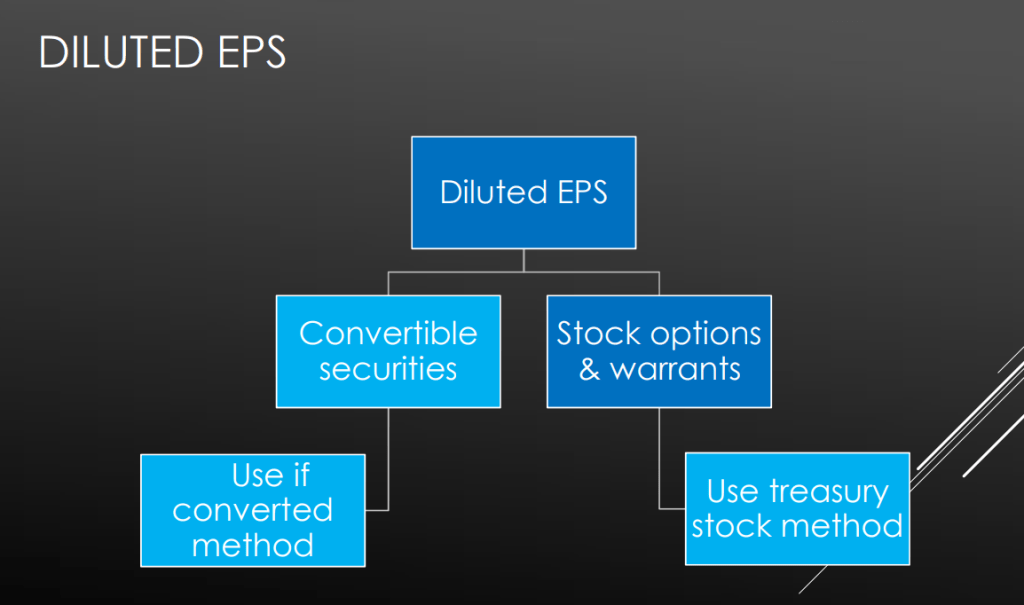
Diluted EPS reflects the effect of all the company’s securities whose conversion / exercise would result in a dilution (reduction) of basic EPS.

Dilutive securities includes:

  1. convertible debt,
  2. convertible preferred shares,
  3. warrants,
  4. Options
  5. Employee stock options

Calculation of Diluted EPS

Diluted EPS =

(Net income available for common stockholders + Income adjustments due to dilutive financial instruments) / (Weighted average number of shares outstanding + Newly issuable shares due to dilutive financial instruments)

Diluted EPS on Convertible Preference shares using if converted method:

The conversion of preference shares has two effects on diluted EPS formula:

  1. Increase in denominator of outstanding shares on conversion of preference shares
  2. Increase in the numerator (Net income available for common stockholders) by dividends on convertible preferred stock.

Let’s understand this with the help of below example:

Net income$11,800
Ordinary shares 5,000 shares outstanding
Preferred shares ($2 dividend per share each year)
900 shares outstanding convertible into 2 ordinary shares
Total Preference dividends for the year $1,800
Basic EPS ($11,800 − $1,800) / 5,000 $2.00

Adjusted net income attributable to ordinary shareholders =

=11,800 + 1,800 ( Preference shares dividend no longer payable on conversion)

= $13,600

Number of shares outstanding on conversion of preference shares = 2000+ 1,800 = 3,800

Diluted EPS = 13,600 / 3,800 = $3.58 per share

Diluted EPS on Stock options using Treasury stock method

An option or warrant gives the holder the right to buy shares at some time in the future at a predetermined price.

Treasury-stock method assumes that proceeds received on exercise of the options is used to buy back shares at the average market price.

To calculate diluted EPS with an option, you need to work out the number of ‘free’ shares that will be issued if the options are exercised, and add that to the weighted average number of shares

Diluted EPS is calculated as if the financial instruments had been exercised and the company had used the proceeds from exercise to repurchase shares of common stock at the average market price of common stock during the period.

The weighted average number of shares outstanding for diluted EPS is thus increased by the number of shares that would be issued upon exercise net of the number of shares that would have been purchased with the proceeds.

We will understand this with the help of below example:

Net income$12,000
Ordinary shares shares outstanding2,000
Basic EPS ($12,000) / 2,000) $6
Stock options (200 options with exercise
price of $80), 200 shares to be issued on exercise
Average market price per ordinary share during
the year
$100

Proceeds from exercise of options = 200 x $ 80 = $ 16,000

No. of shares purchased from proceeds of exercise =$ 16,000 / 100 (average market price) =160 shares

Total number of shares outstanding = 2000 + 200 – 160 = 2040 shares

Diluted EPS = 12,000/2,040 shares = $5.88

Antidilutive security

Antidilutive security is a potentially convertible securities whose inclusion in the computation results in an increase in EPS than the basic EPS or a reduction in loss per share.

Under IFRS and US GAAP, antidilutive securities are not included in the calculation of diluted EPS.

Summary

Diluted EPS is an important metric for investors to know how much will be the potential dilution in earning per share if all convertible securities were exercised.

Related articles:

What is Earning per share (EPS)

What is PE Ratio?

What is Earnings per share (EPS)?

Earnings per share (EPS) is the company’s net profit available to equity shareholders (common stockholders) divided by the number of outstanding common shares.

EPS is reported on the face of the income statement / profit & loss statement.

How EPS is calculated?

Earnings per share (EPS) (also known as Basic EPS) is calculated as under:

Basic EPS  =   (Net income – Preferred dividends) / Weighted average  number of shares outstanding

The weighted average number of shares outstanding is calculated by the length of time each quantity of shares was outstanding during the year.

Example: A company has reported following numbers on 31.12.20X1:

Particulars$
Net income (PAT)1,300,000
Preference shares 10%, 2,000,000 shares of $1 each2,000,000
Common stock outstanding on 01.01.20X1 400,000 of $1 each
Common stock issued on 01.07.20X1 400,000
Common stock repurchased on 01.10.20X1 200,000
Common stock outstanding on 31.12.20X1 600,000
EPS llustration

Step 1: Calculation of weighted average number of shares outstanding:

400,000 shares * 6/12200000
8,00,000 shares * 3/12 i.e. (400,000+400,000)2,00,000
6,00,000 shares * 3/12 i.e. (800,000-200,000)1,50,000
weighted average number of shares outstanding5,50,000

Step 2: Net profit available to equity shareholders = PAT – Preference shares dividend

= 1,300,000 – 200,000* = 1,100,000

Step 3: Basic EPS = 1,100,000 / 550,000 = $ 2

*10% of $ 2,000,000 Preference shares capital

Utility of EPS

  • A comparison of year on year EPS growth indicates that profit per share is increasing which is positive for investor and vice versa.
  • From investor perspective, EPS indicates how much profit is earned on each share.
  • EPS is used an input into the price/earnings ratio.

Related articles:

Diluted EPS

What is PE Ratio?